These are all early spring photos, that I didn’t get around to posting before.
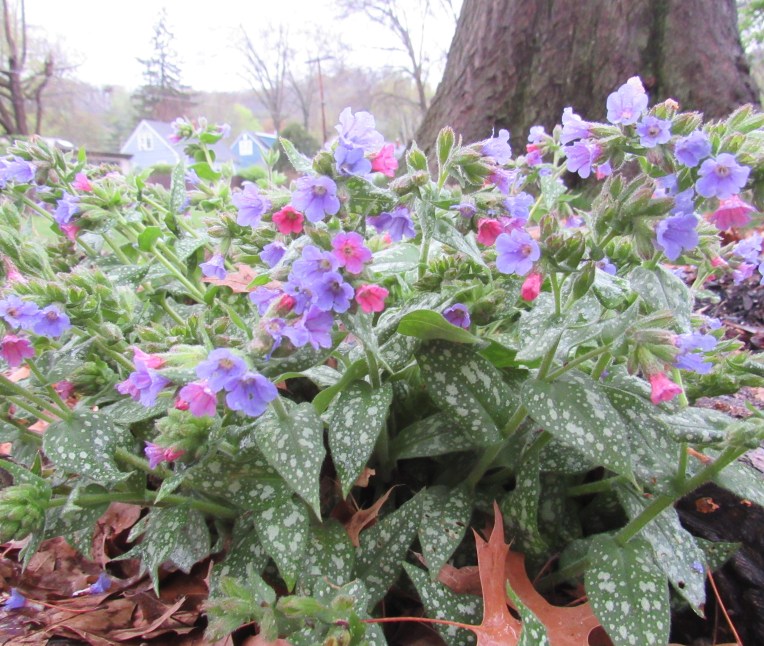
This one feels uplifting to me. I got down close to minimize the distortion, and ended up with a distant sky view. Pulmonaria is a foliage plant that also flowers beautifully. This variety is Trevi Fountain. I have the best luck keeping them from year to year by planting in a shaded, raised area. I water whenever the leaves floop a little, but I want all my perennials to dig their roots deep, so they are as water-independent as possible. I never fertilize these.
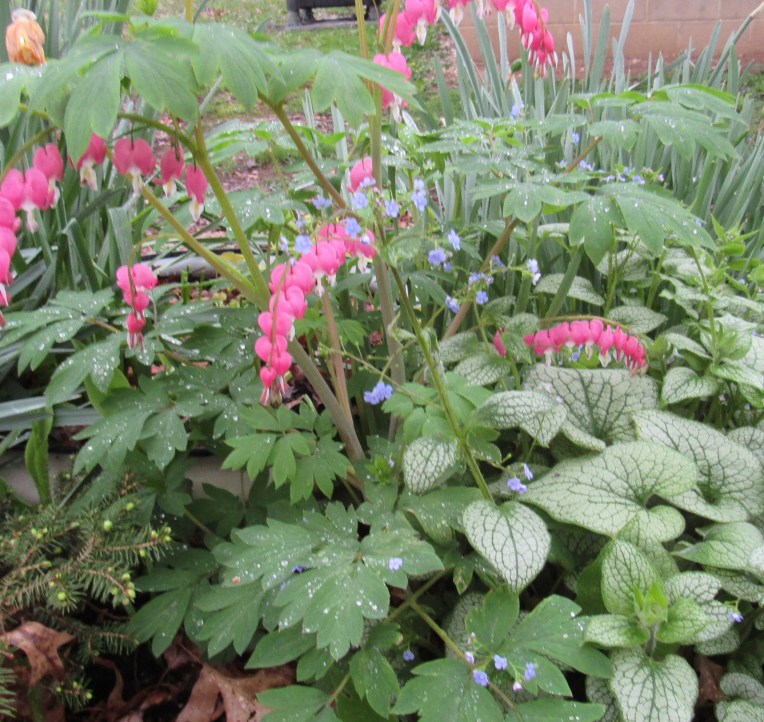
A combo of close-grown shade perennials, lush in appearance with the brunnera and bleeding heart pushing their leaves through each other. Then they’re blooming together, so the bright pink and white is mingled with the blue. In the corner is a bird’s nest dwarf spruce, always pretty when its candles (nubs of new needles at branch tips) sprout.
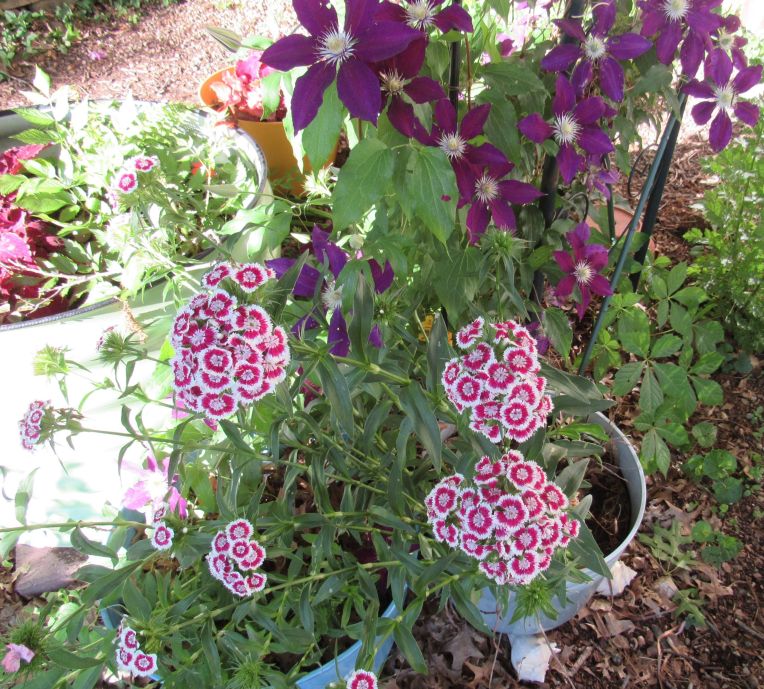
This came by surprise, but looked really great. The clematis is Vagabond, a big bloomer and climber when mature, purple flowered with raspberry stripes. The last I read of this variety, it was listed as “hard to find”. But maybe someone is selling Vagabond again. It wants bone meal at the roots, well watered in, in my loamy clay soil. The potted plant is classic deep pink and white Sweet William. Sweet Williams are so pretty and accommodating, that you might as well cut off the seedheads and strew them around your garden every year.
I believe this is Eupatorium serotinum, White Boneset, native to North America. Last year it got above five feet tall, and had a huge florescence. As with typical Eupatoriums, a genus Joe Pye Weed was once considered belonging to (Joe Pye is now Eutrochium, still very similar in appearance to plants called Eupatorium), the flowers are feathery and clustered. In the case of E. serotinum, the flowers are white, not pink. White Boneset blooms late in summer, and attracts dozens of pollinator species. Mine last year was in a constant cloud of activity. My garden also has two kinds of Joe Pye weed, plus Eupatorium coelestinum, called Blue Mistflower. Eupatoriums/Eutrochiums are highly beneficial to insects. All of mine have leaves perforated with round holes, as above, a sign (probably) of moth caterpillars. I know my yard is full of tiny moths, that pop up out of the grass as I walk around.
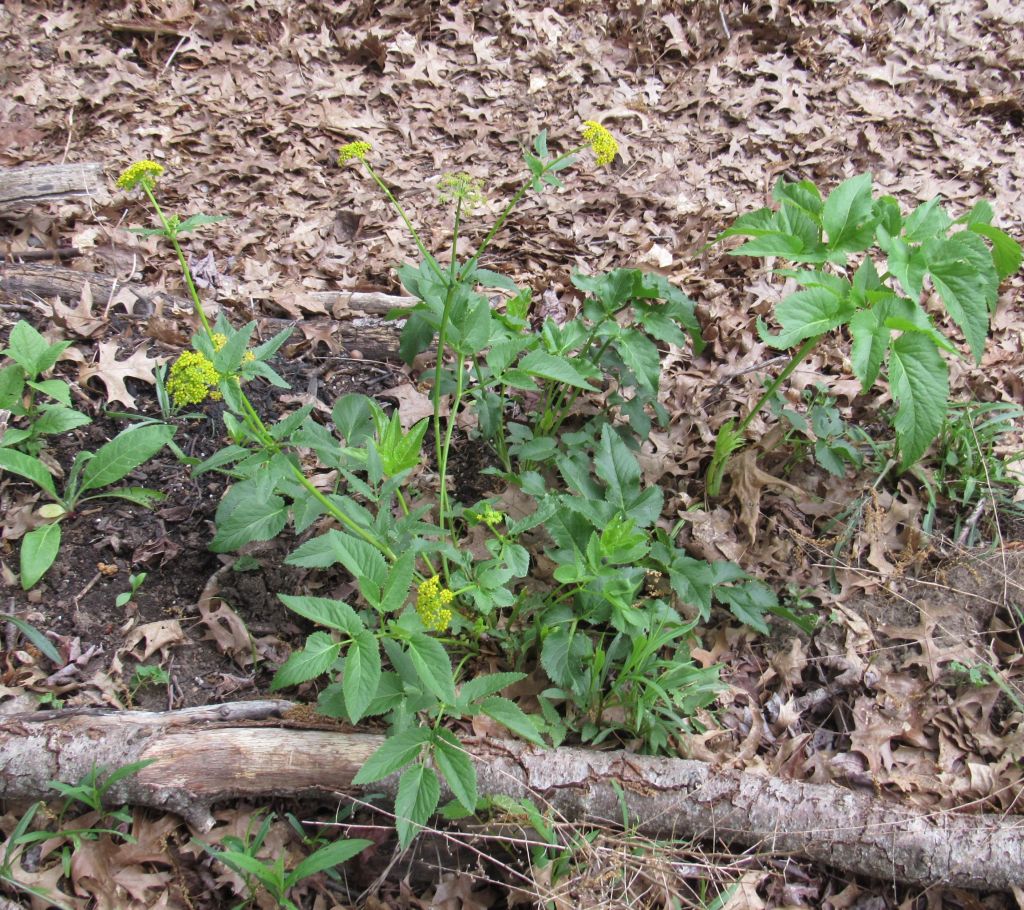
This is Golden Alexanders, Zizia aurea, a host plant for Black Swallowtail butterflies. In my yard, I don’t see that many Black Swallowtails; I get mostly Spicebush. So far I haven’t seen anything eating my Golden Alexanders, but just as an ornamental they’re striking, a garden plant you’d think would be more cultivated. They sprawl a little in their growth habit, as you can see, so they provide their own soil cover to conserve moisture.
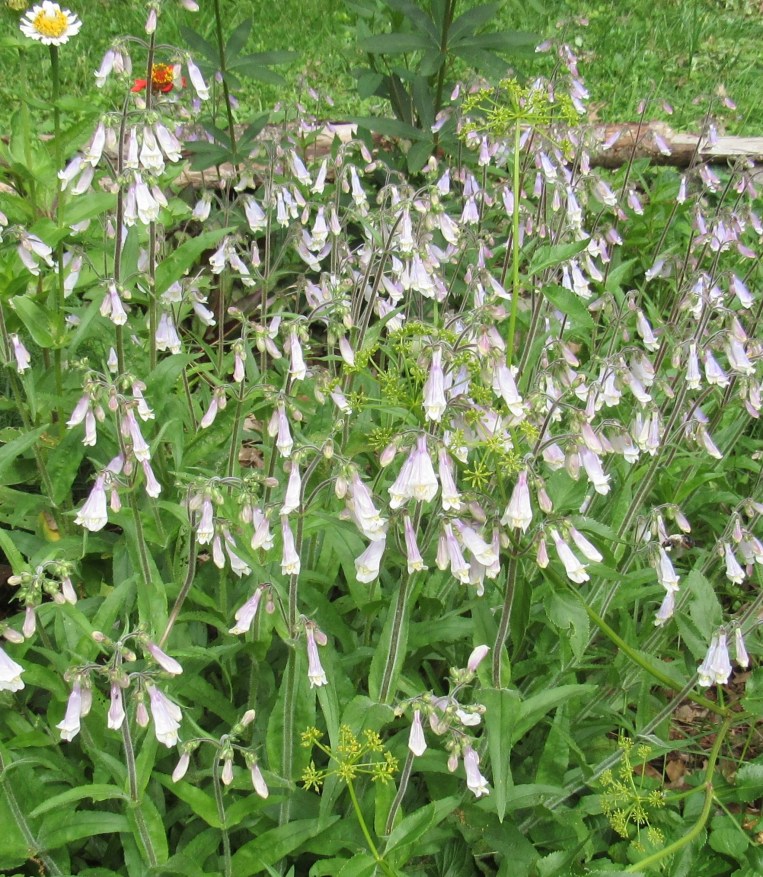
These are Hairy Penstemon, Penstemon hirsutus (some seedheads of Golden Alexanders can be seen among the blooms). In this photo are only three plants. Each plant must have a hundred flowers, and the flowers have lasted at least three weeks. They first bloomed so early that there weren’t a lot of bumblebees hatched yet. They’ve been mostly pollinated by small bee species, but one of the smaller bumblebees can be seen at the middle right margin. Fantastic display from these.
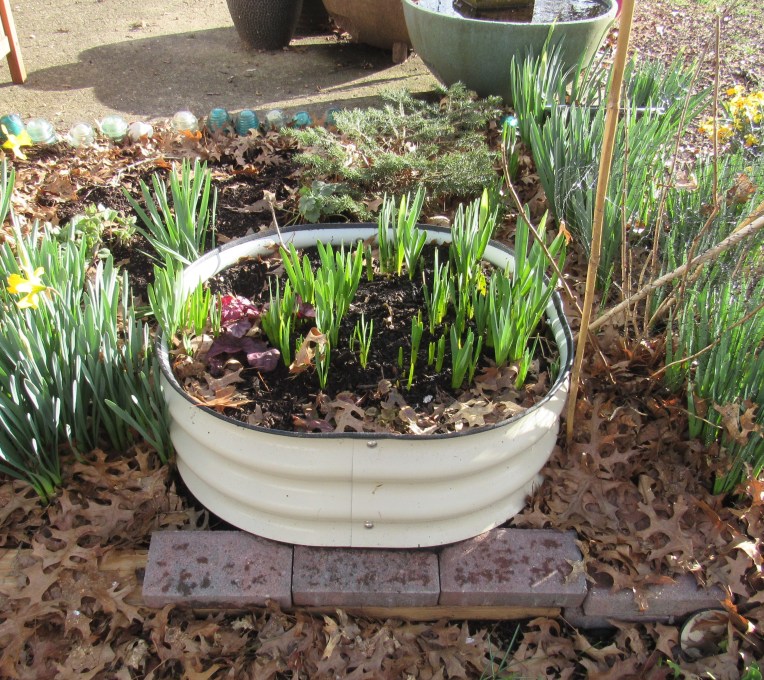
This picture is a few weeks old now. I’ve been meaning to get some garden chat on the blog, but keep having so many other tasks. I love these metal planters. The configuration above measures about a two-foot circle. I’ve been wondering for a while why you can’t buy pots open at the bottom, so you can plant shrubs and dwarf trees that need to root into the ground, but need the protection of a planter. Raised beds also serve a certain aesthetic; plus they have a habitat function, a topic I’ll have more on later. Anyway, the aluminized steel planters are open, easy to put together, fun to choose colors, etc. I thought one would give definition to this bed, as well as suppressing my non-blooming daffodils. (I actually had 6 blooms, but tons more foliage that I just snipped away today, since I don’t really want these daffs.) I’ve told the story before of how they’re so deeply buried a shovel blade’s depth can’t reach the bulbs. I can’t dig them without destroying my other plantings. But…
As you can see, they grew all the way through a foot of dirt. Now they’re even deeper! (I’ll just have to kill them slowly.)
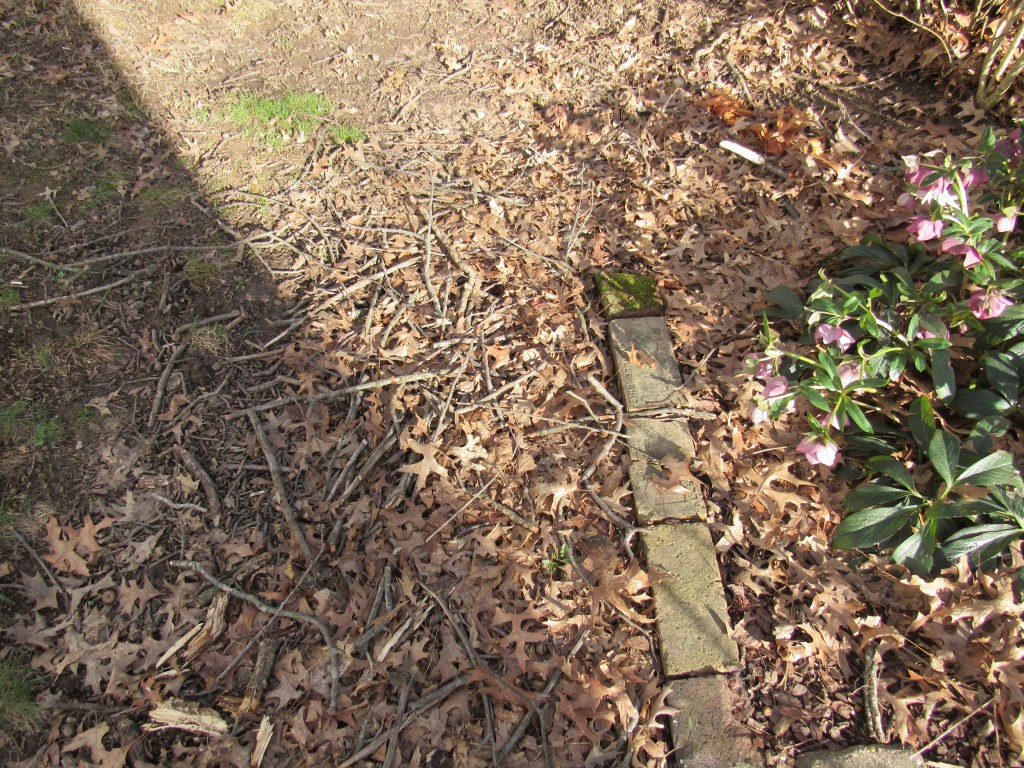
Here’s an area where every heavy rain washes the ground bare. You can see plain mud at the top of the image. When I gather sticks, I break them up and strew them over leaves and garden cuttings. It makes a good free path cover, and stops the washing. But I’ve got a ways to go to stabilize this shallow ditch between my property and the neighbor’s.
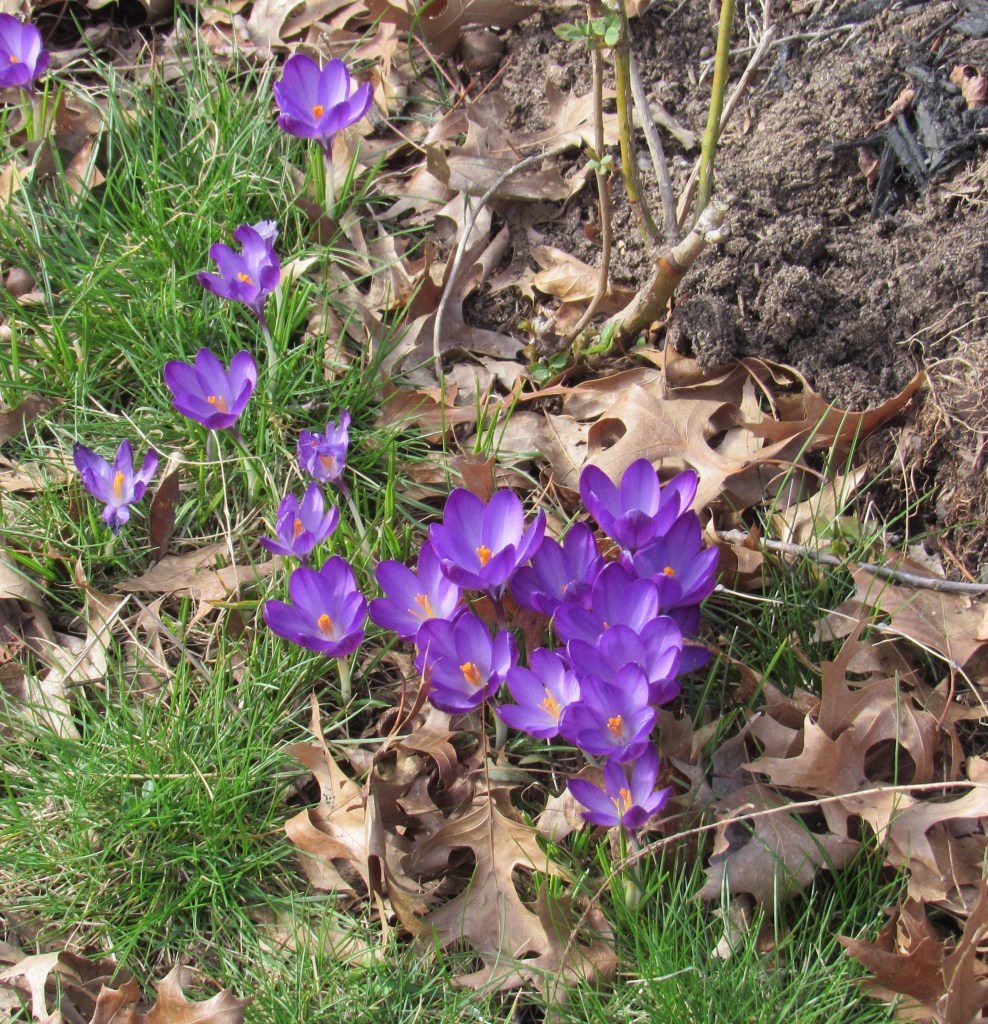
When I was shopping for bulbs last summer, I felt kind of unenthused about crocuses. I bought a few species ones, that I wrote about planting under store bought soil. But the usual purple, white, and yellow just wasn’t inspiring… Until this spring, when I saw how great these clusters of purple were looking. The daffodils (the ones I have where I want them) have been fantastic this year, too. My next orders will be mostly daffodils and crocus.
Though, next spring, I may get inspired by my alliums and “uncommon” bulbs, and decide I need a lot more of those.
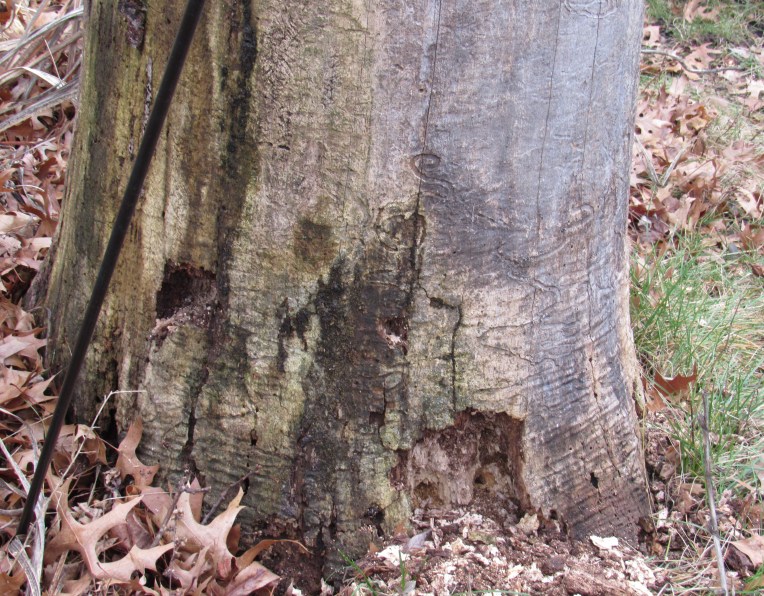
Above, the ash stump I’ve been using to support a large pot. I bought a new pot in the fall, the dish style that’s becoming popular. A lot of pots are too vertical, and plants don’t benefit from soil that packs at the bottom and ends up either soggy or dry.
Now the pileated woodpecker is taking my stump apart. We’ll see if it survives as a garden feature! But it’s wonderful to have an insect-intensive habitat, attractive to our largest woodpecker. What larger animals need most crucially is space—enough trees, in the case of the pileated, to hammer out their nest holes. If the babies live to adulthood, each male will have to find a territory of his own. The more we build habitat in our back yards, the more we sustain a path for nature to migrate, with food, water, and breeding sites, and the more nature we have on Planet Earth.
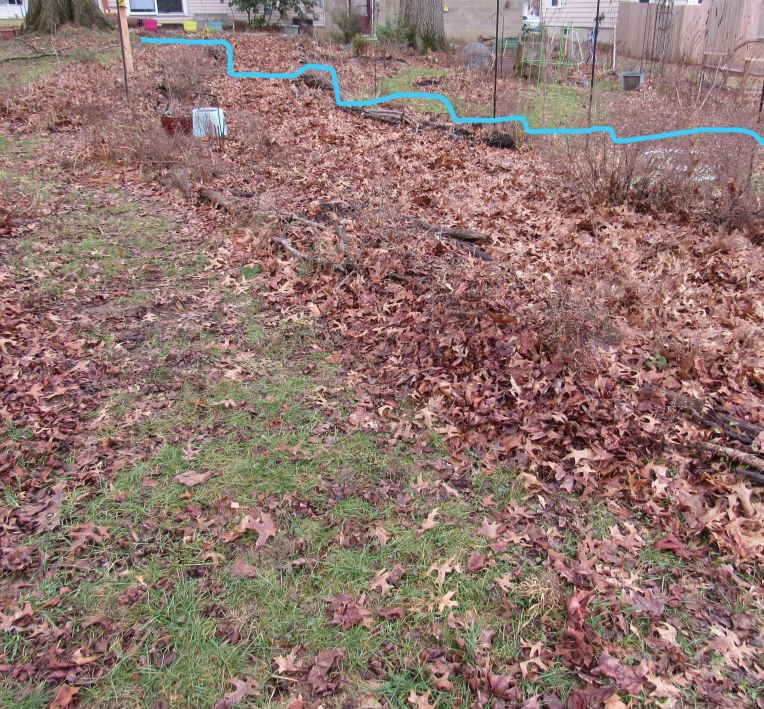
We’re having very pleasant spring weather, this late mid-winter. Even so, it’s a little worrisome, because a bubble of warm, dry air that lingers more than a week is not a pattern we want repeated through summer. Hopefully, El Nino interruptions are passing, and things will be as normal this summer as they can. The blue line above shows how I’ve changed the lay of my yard with shallow terracing. When we get heavy rains, the water goes downhill slowly, mostly soaking in. This terracing keeps my garden water-retentive, so plants root deeper, and can hold their own in dry spells. It’s easy to terrace your own yard, even if it has no natural hill. Make paths edged in fallen logs and sticks, or in wall blocks from the garden center, or even a load of firewood, repurposed. Use compost, yard waste, and purchased soil to fill in planting areas. The flow of water, plus soil activity from all the creatures you’re inviting, shapes the surface.
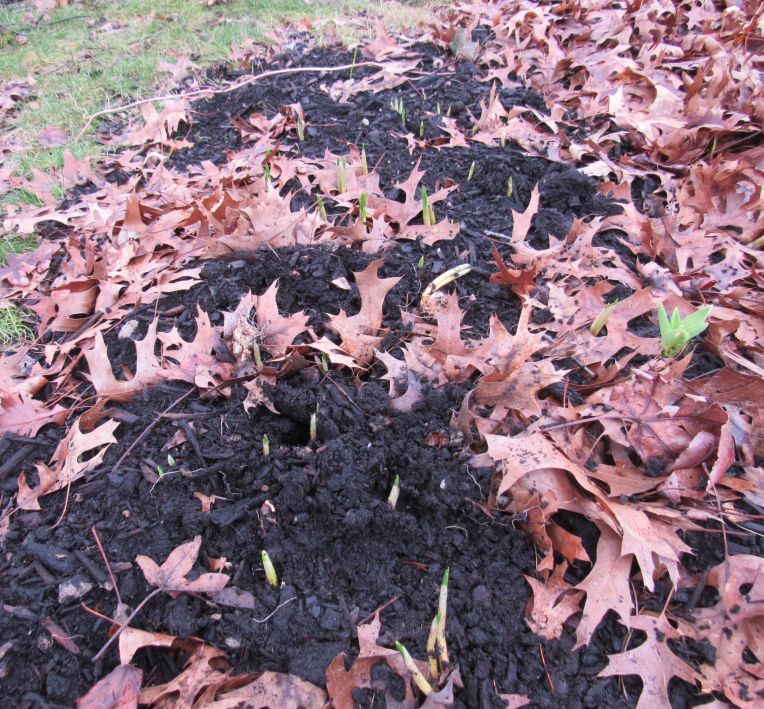
A few posts ago, I showed the easy way to plant small bulbs. Here are my crocuses coming up, and when they’re finished blooming, I can fill in around them with annuals and new perennials.
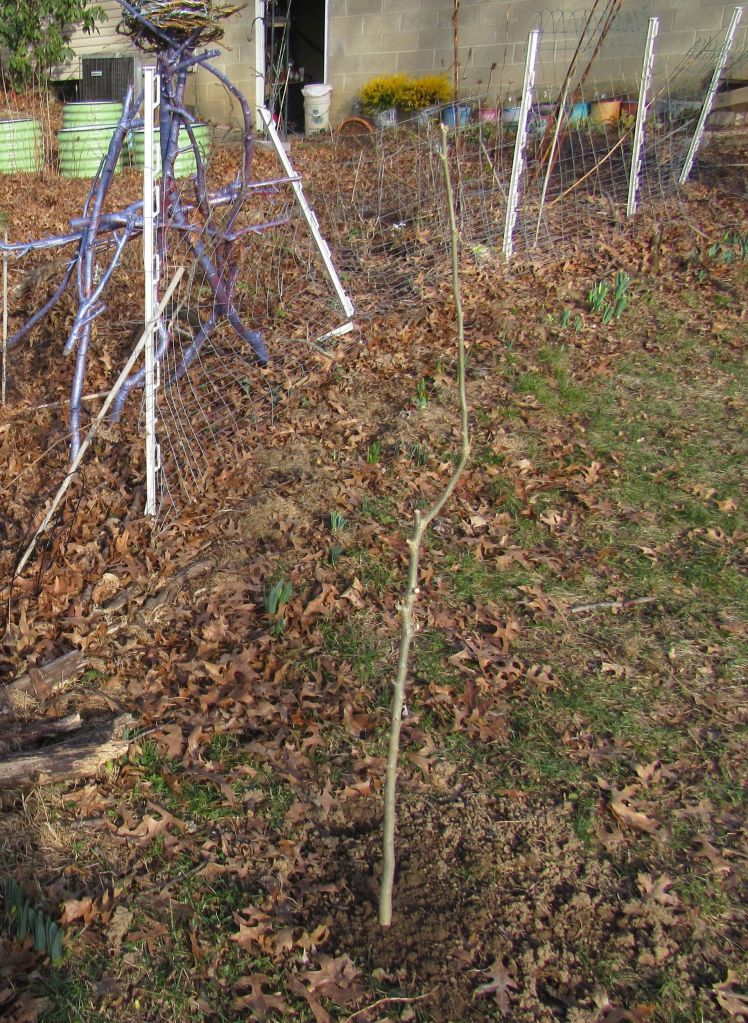
This is not a tree, it’s a Rose of Sharon. I’ve been pruning it to grow straight up, and my plan is to train a clematis on it. With luck, I’ll have the “post” flowering as well as the vine. Since Rose of Sharon is free—at least many of us find them sprouted in our yards, whether we like them or not—we have room to experiment.
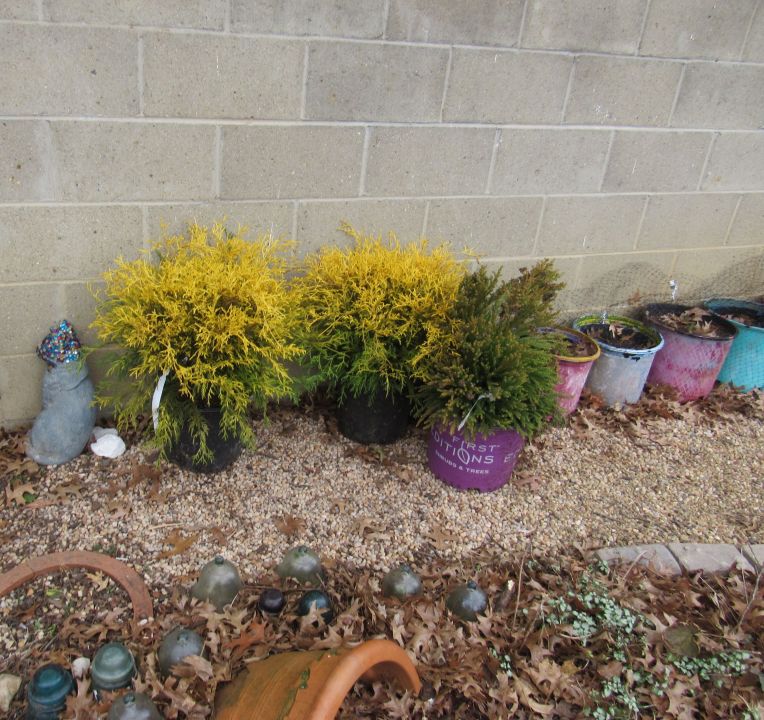
Finally, a pic of some shrubs, two yellow chamaecyparis, and a green cryptomeria, that should turn bluer when it gets new growth. I ordered them from Plants by Mail, and you can see that what arrives on your doorstep is impressive.
Last year, as I recounted, I started my seeds too early, and ended up with sad veg plants not ready for the cold snap that lasted most of May, after an unseasonably warm April. I also had gallon pots of dahlias, salvias, and petunias to carry in and out every day until last frost. This year, I’ll work harder at it…putting off the temptation, that is, to have some indoor garden going in February. My goals are to spend less, spread out my “I want it” list over a couple of years, instead of getting everything at once, grow lots of aster family annuals (the most reliable for not being eaten by deer), and design with the principle I took to heart last year—don’t buy six different plants, buy six of one variety and plant them in close bunches. It’s a more workmanlike approach, so less exciting, but the result is a better display.
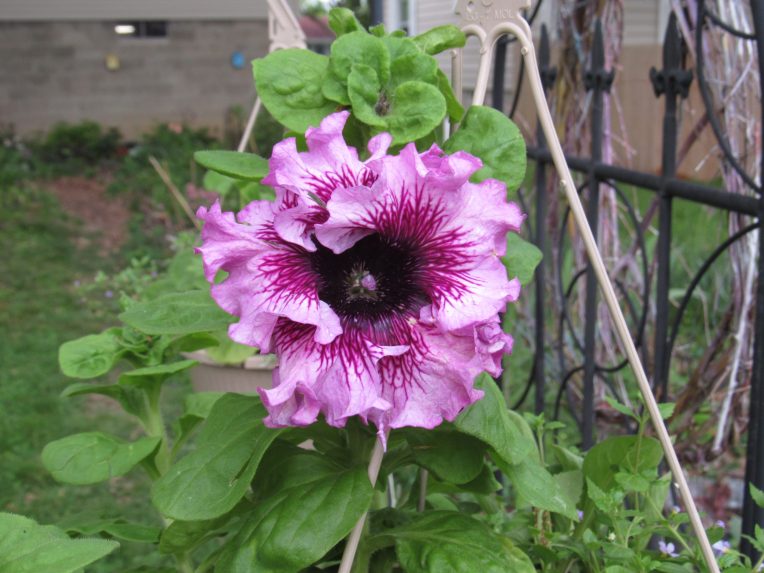
Above, the (fairly) new petunia, Spellbound Pink. I think you can buy seeds for this at Burpee. It not only looks like a hibiscus, with flowers that grow four inches wide, it also performs more as an upright plant, so is good for beds rather than hanging baskets. Another variety from last year I loved and recommend is the Black Krim tomato. Really delicious! That one is available several places; I got mine from Seeds n Such. They also carry Old German, another I tried last year and reordered this year—one of the prettiest tomatoes, as well as tasty. Of tomatoes, I harvested as many as I could use last year, without needing much deer protection, just ladders covered with netting. I had great peas, but my beans, squash, and corn never took off. I bought melon plants that didn’t get an early enough start, or enough sun. Peppers do well for me, and if they didn’t take so long to bloom, my romanesco broccoli would have done well. The plants were still going strong when it got to be winter, but the deer couldn’t leave them alone. This summer I’ll be growing all my hoped-for and sometimes successful favorites, but probably no potatoes. I can’t get potatoes to do much in pots, and I don’t have horizontal space for them.
The saddest thing that happened was a case of rosette disease on one of my roses. I dug it up, reported it, and now I’ll have to see if my other three roses are good. I get beautiful catalogs from David Austin, Edmunds, and Jackson Perkins, but I can’t afford to order.
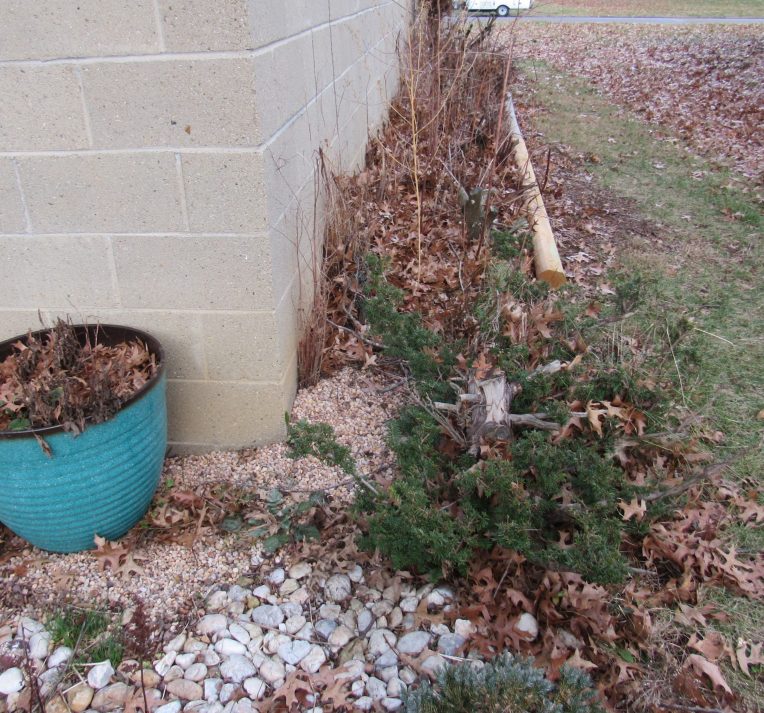
Here is an easy way to get a new bed to make itself. I just laid two landscape timbers along the side of my garage, and I’m allowing leaves and plant detritus to accumulate, along with flowerheads I cut from the garden and scattered in this space. The soil-building and weed suppression will proceed on their own, and the bed will be more than halfway ready for augmenting with other things, coneflowers, rudbeckia, etc, that I dig up from the rest of the garden.
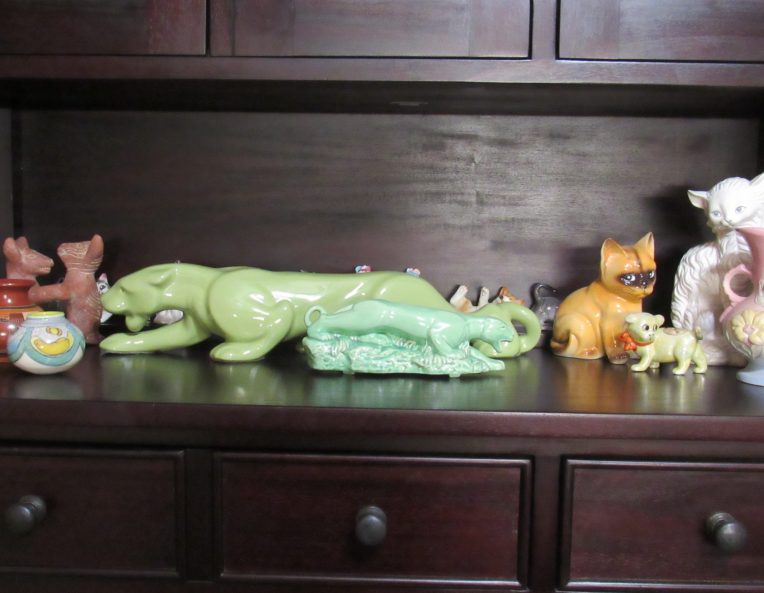
Here’s a happy find. I’ll talk more this year about my collections, and thrifting trips, and showcase things I’m selling on ebay. The green panther TV lamp has been in the family for decades; I got it about twenty years ago from my grandmother. But I was browsing the local antique mall and found a green panther planter. More of a blue-green, but very cool to have this motif in another piece!
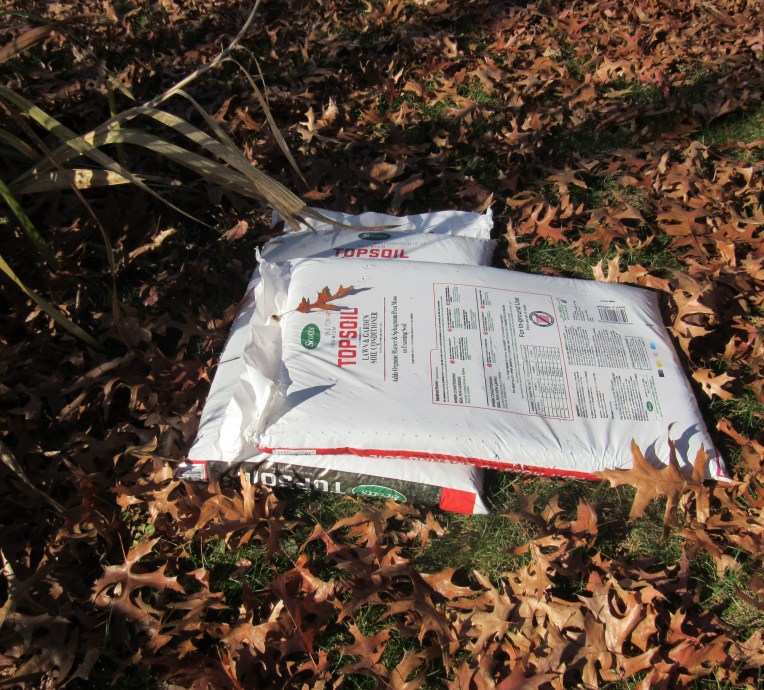
If you’re planting small bulbs, like crocus or several of the allium varieties, which can be placed under a few inches of soil, here’s a way to avoid digging at all, while laying the ground for a bed-expansion in next year’s garden. Buy a few bags of topsoil….
I know you can find advice out there against it. But the bagged products have the reputation of both the manufacturer and the chain store selling them to support, and they have laws to comply with. It’s not the same as topsoil delivered from a random seller online. I like this less augmented (with fertilizers) product, that allows soil organisms to build fertility for you. The brand above is like half-decomposed mulch, not heavily peaty, and after a good rain its light particles sink below the heavier ones, forming a mulch layer on their own. Of course, you can buy a lot of commercial brands, and should pick the kind best for the soil you have.
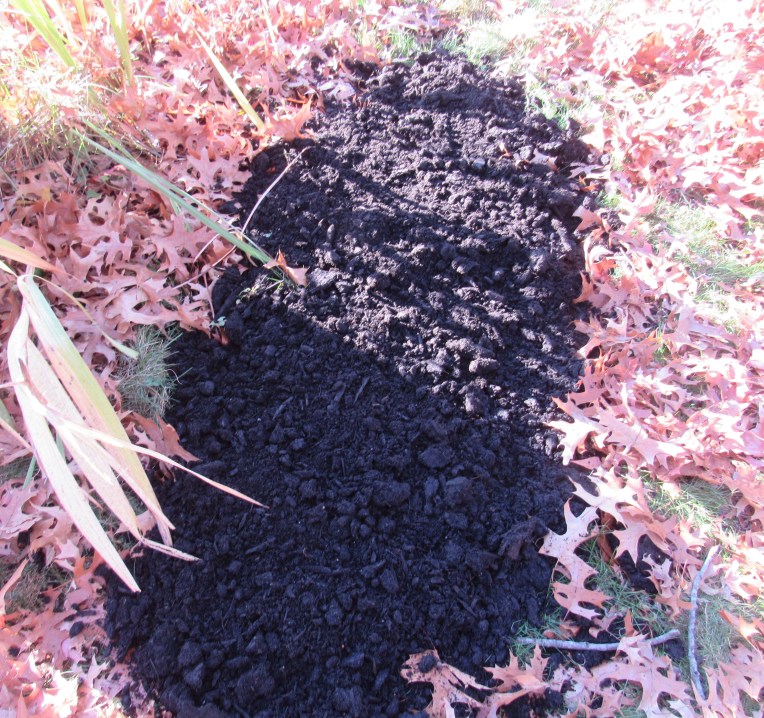
Distribute the bulbs, which will root by themselves whether upright or on their sides, in a natural flow. Never mind the grass. Fescues mostly die when well covered, and the stringy roots are easy to dislodge in the spring.
Distribute soil over the whole planting, to about three inches depth for crocuses.
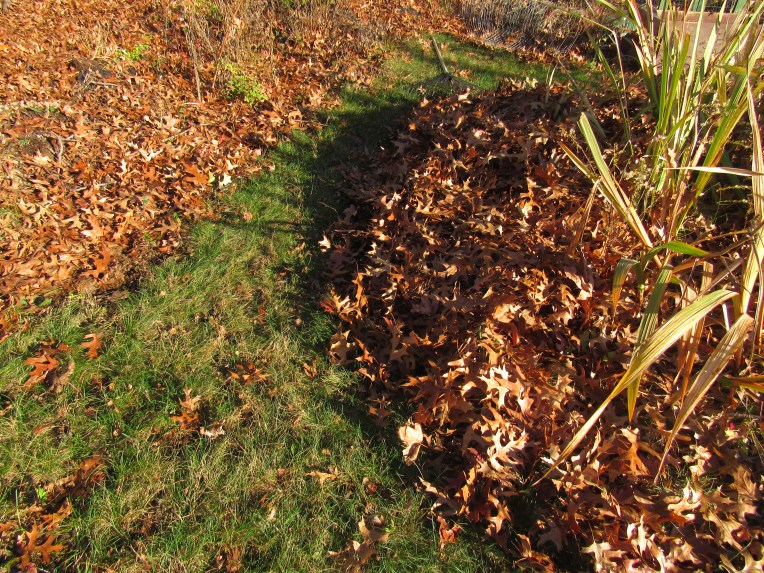
Finally, I’ve raked on leaves to protect the bulbs from squirrels, and keep them from being exposed by rains. The leaves will add richness to the bed, but if they’re oak, should be thinned in time. When they begin to form a mat, your bulbs and perennials alike need light and air, so you should do a general midwinter raking (that is, late January, early February), taking about half the leaves away for composting.
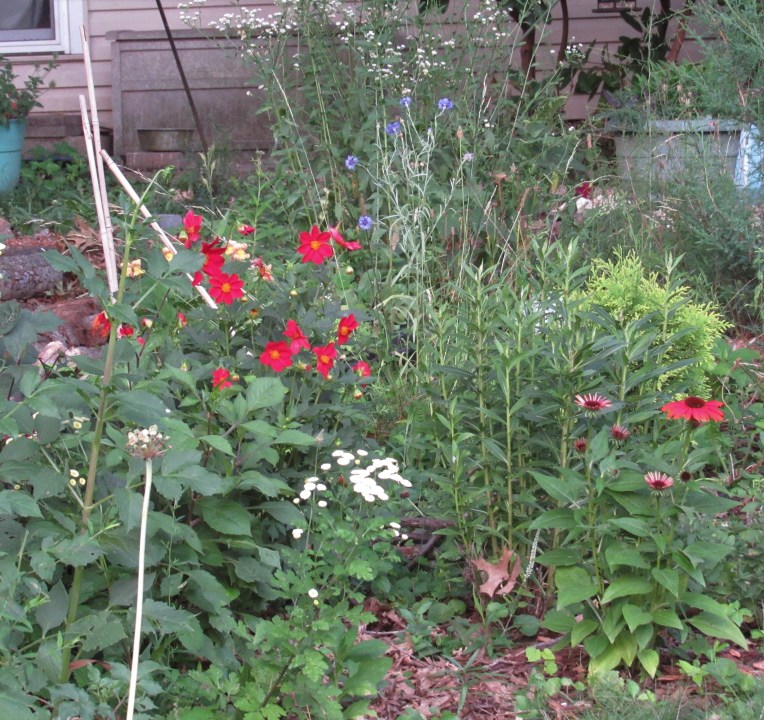
From mid-summer of this year, a meadowy mix of cultivated and wild flowers. The erigeron in the back is a volunteer. I don’t know what species, but one that puts out dozens of small white flowers, wafts in the breezes, and grows two to three feet tall. Then I have red dahlias, blue centaurea, light-yellow feverfew, rosy-orange coneflower, and the yellow-tipped foliage of Golden Globe arborvitae.
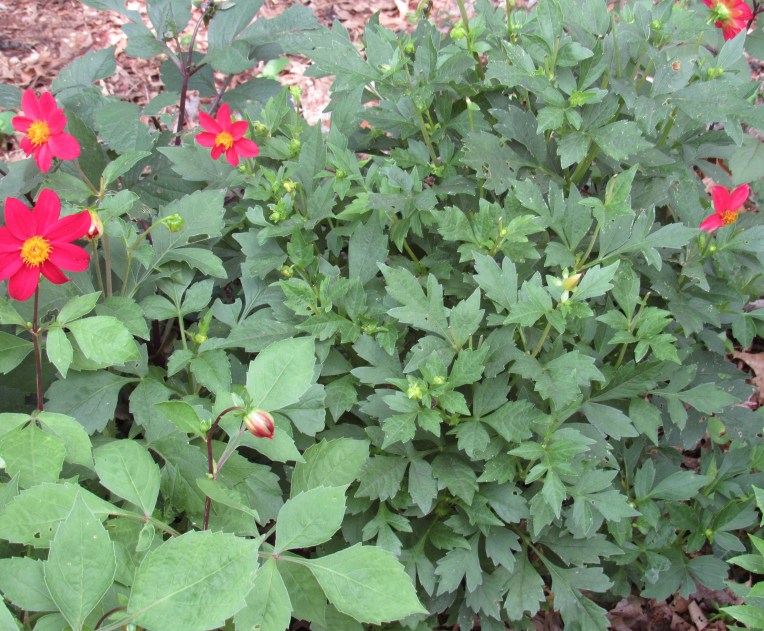
Here are the red dahlias up close. They’re the open flowered, pollinator-friendly kind, and as you can see, the one on the right thinks it’s a mum. Lots of small leaves, lots of flower buds. But they still bloom dahlia-style, in succession—so for all the buds, it can’t quite achieve the loaded look. These have a sheltered spot along the path, and survived from last winter.
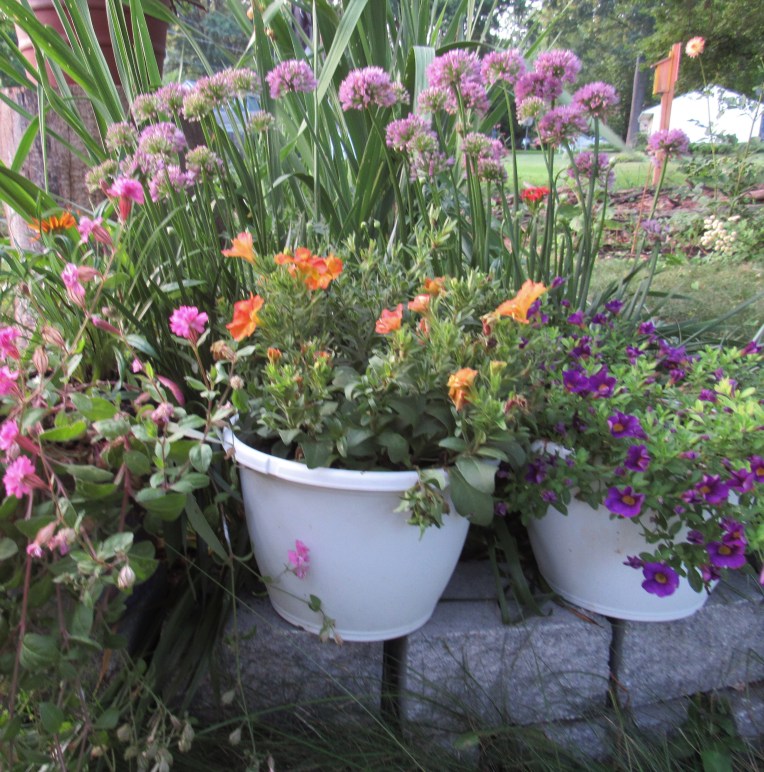
Here are two hanging baskets I got for five dollars each. I took the hanging part off and perched them on this little wall, where until fall arrived and the deer ate them (two calibrachoas in this color-wheel perfect combo of orange and purple), they bloomed gorgeously.
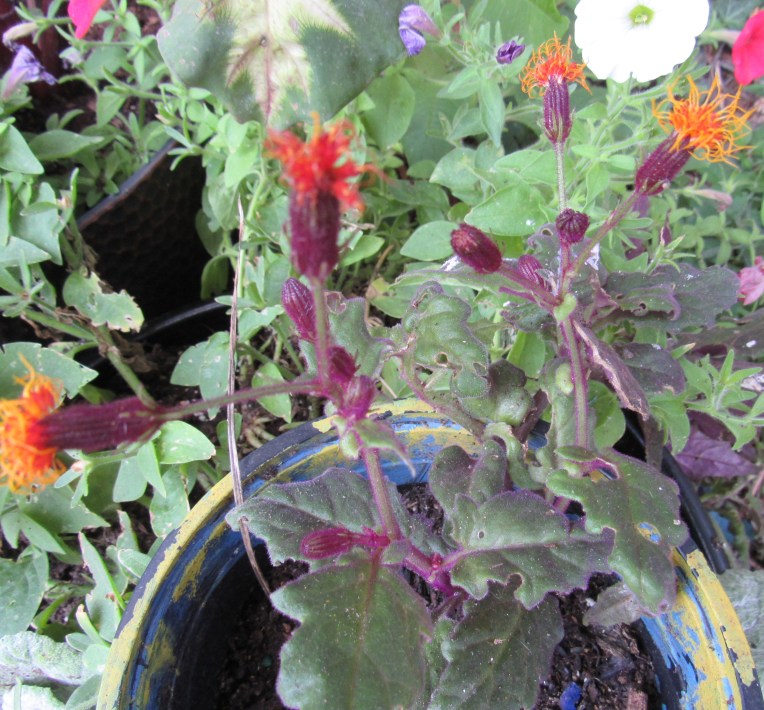
Purple velvet vine looks exotic, and is usually sold as a houseplant. Mine got an intractable case of mealy bug, so I put it outside. Here you see its fantastic little flowers. When they’re finished, they turn into white puffs, like asters. And that’s because this fancy plant is a member of the aster family…who would guess? I brought it indoors for winter, found it still had mealy bug (though it seems not much bothered). I put it in a hanging basket before an isolated window in my garage. If it survives, I’ll let it bloom outdoors next summer.
I used a Waikiki and a black-leaved colocasia together in one large pot. (With a few wave petunias.) I think next year I’ll get a third colocasia type, and have three sets of contrasting leaves. I’m wintering these over against the garage wall, and I’ll cover the pot in bubble wrap. That’s how I keep pitcher plants in winter, and how I kept the black colocasia last year. Colocasias can thrive in pots in the house, but you need a really big space for them. For me, keeping tender tubers, corms, etc., in lightly damp sand, or whatever is recommended, just never works. Letting the plants go dormant in an area that won’t freeze is better.
This area, coming downhill along a three-foot drop from the highest part of the yard to the lowest, has not been satisfactory. It’s all under oak shade, nicely dappled, but the roots allow almost nothing to grow naturally. The principle for planting under trees is build up, don’t dig down. One way is to construct three-quarter boxes from logs or stones, angled to the slope, and fill them with soil, then add a small shrub or perennial, and let it root in. I’ve made some pleasant areas with mostly shade plants, but as you can see middle left, a sunny section too, of sedum and hen and chicks.
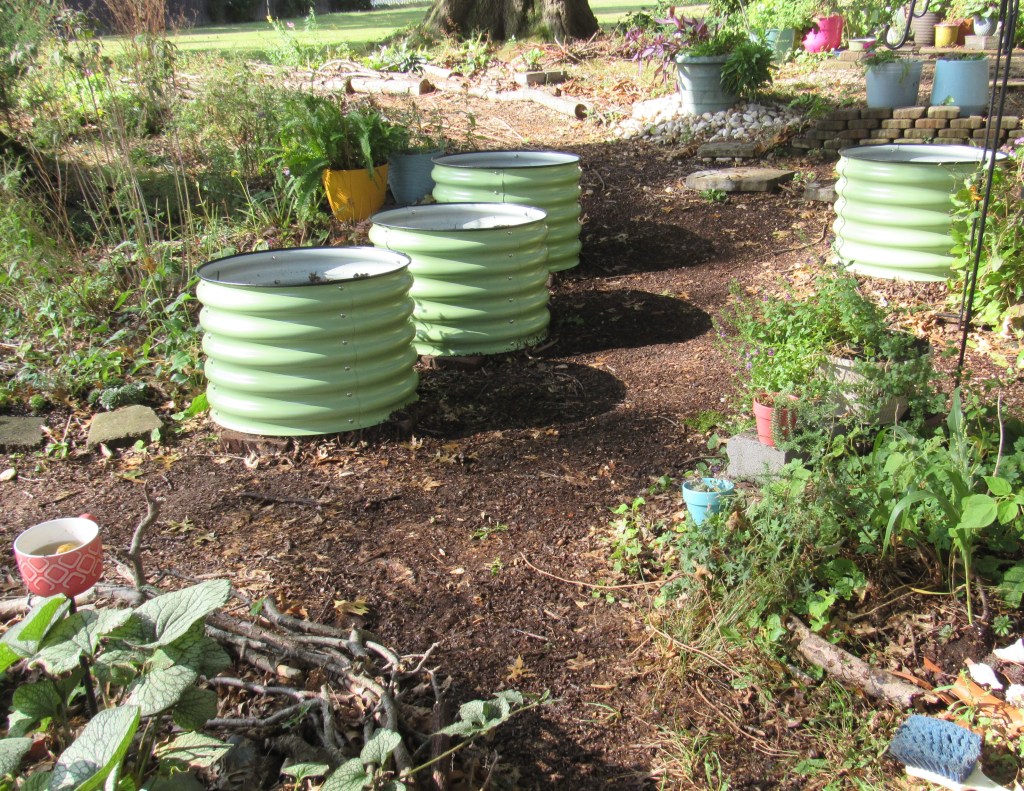
My pathway here has been both devoid of growing things and over-large, spanning about five feet. A path should feel cozy. I chose these round planters to make a wall, in effect, that narrows the space, with one planter on the other side for an entry. I’ve filled them with leaf mould, and one bag of topsoil to finish. They’ll settle through fall, winter, and early spring, and should need another couple of bags each to top them off for planting. My plan is to do what I’ve know I should, and haven’t been serious about…
When I plant shop, I buy six different types of perennials, where I ought to buy six of one type, and divide them into two clumps of three. So I’m going to have heucheras, astilbes, and a single Wiggles and Squiggles hosta for each planter, and have this repeat down the hill, in the style of a true border. (I do have a dwarf Japanese maple in mind for one of the planters.)
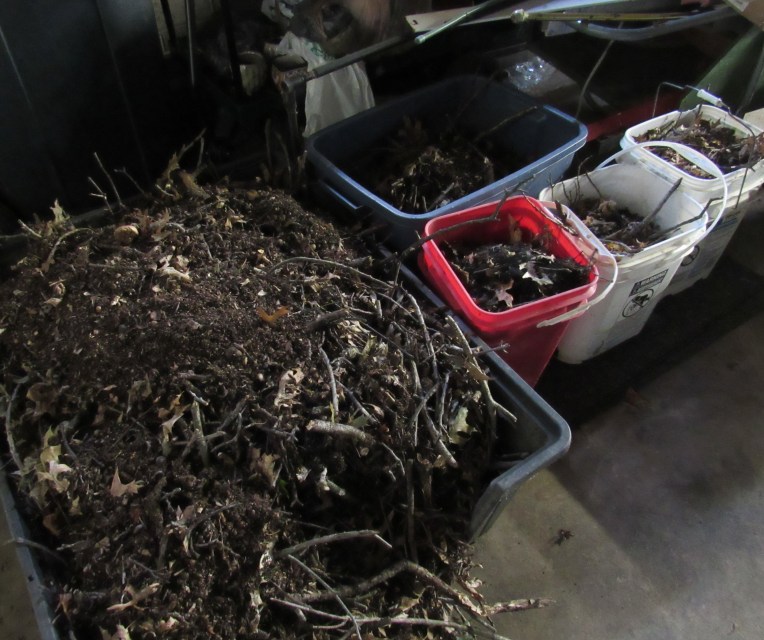
I had my roof cleaned after several years. From the ground the mess looked like a bunch of sticks, neglected, yes, but not out of the ordinary. What the men doing the work raked down, was almost soil. Piles of oak catkins had been raining on my roof, and oak catkins decompose into humus very readily. So I grabbed these containers of wonderful soil/mulch mix, only about half of the total. I‘m using them to fill in my hügel-borders.
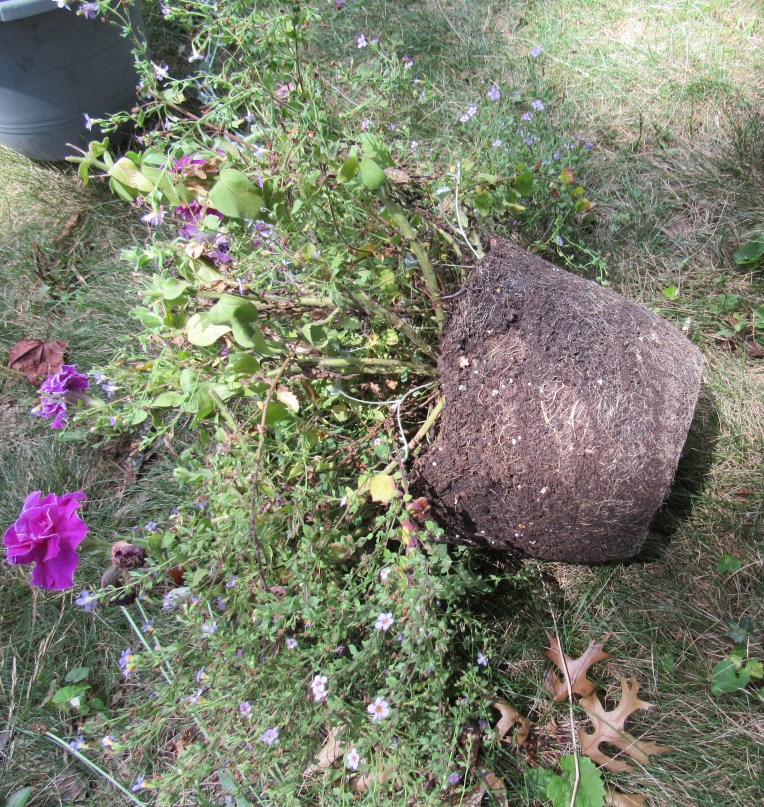
At this time of year, when you water your hanging baskets and they droop the next day, it’s worth pulling out the contents and seeing if you’ve got something like this. Once roots have absolutely filled the basket, you can never water it enough. You can do four things:
Give up, and compost the lot.
Slice the roots into parts, trim down the top growth, add fresh compost to the basket, replant, water well, then rehang.
Get rid of the old plants and buy new ones. Baskets can be filled with mums—even though mums don’t cascade, the look is pretty good going into autumn.
Break up the roots, and plant the contents into a garden bed. With good watering, you can get annual color in your garden until whichever frost is enough to kill the plants. In a warm microclimate, annuals can survive a frosty night, or a few.
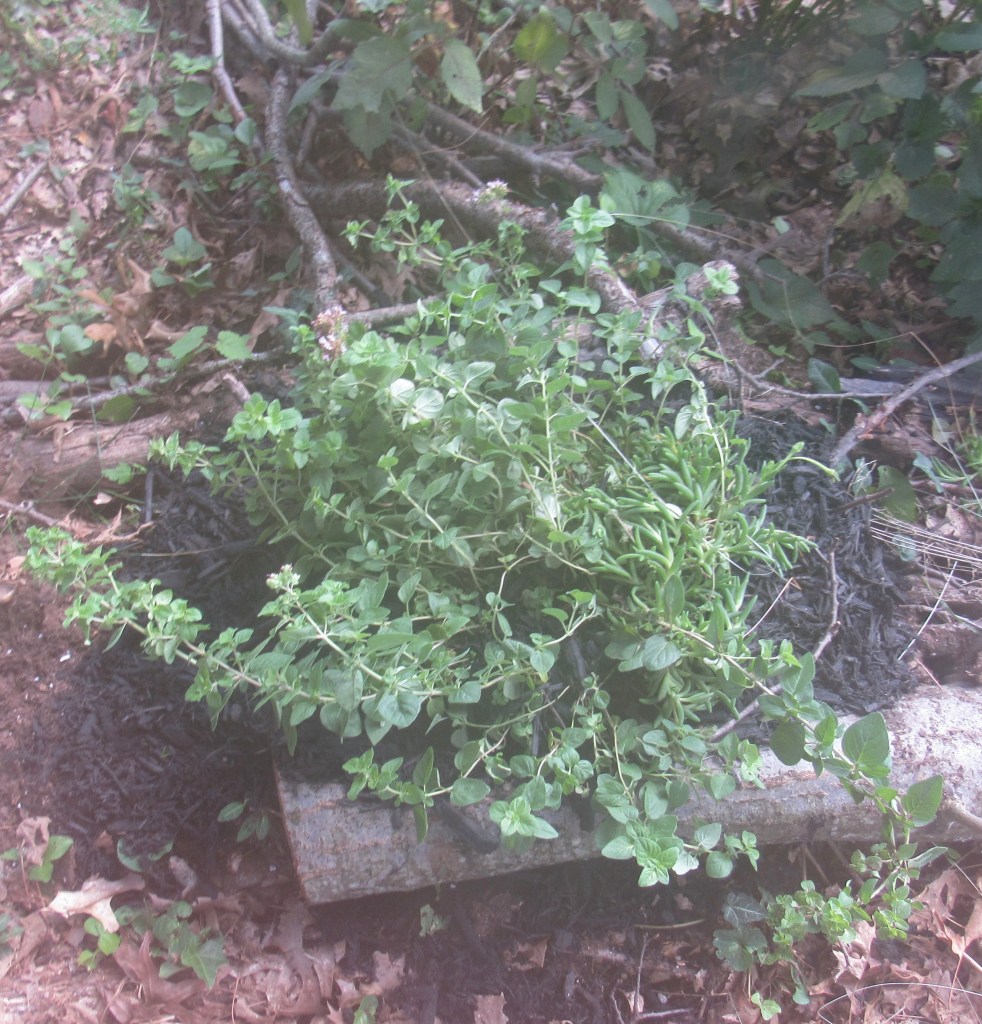
Above is a basket combo that got too root-bound, that I put into the border. I don’t know what this mint family plant is. I think it’s a plectranthus, since it has a trailing habit, and the leaves have barely any scent when I crush them. (The other one is a delosperma.) Ever since the pandemic gardening boom, I’ve had episodes of getting something I didn’t order instead of what I did. I selected a combo of green, purple, and green-and-purple glads, and got green, green-and-purple, and bright tomato red. I got peony-flowered daffodils. I’m not a big double daffodil fan, but these won me over (some things look better in life than in catalogs!) I got (apparently) a cuphea hyssopifolia instead of a white turtlehead. And I got this plectranthus (if it is) that I grew from seed. As far as I know, I’ve never seen seed like this offered.
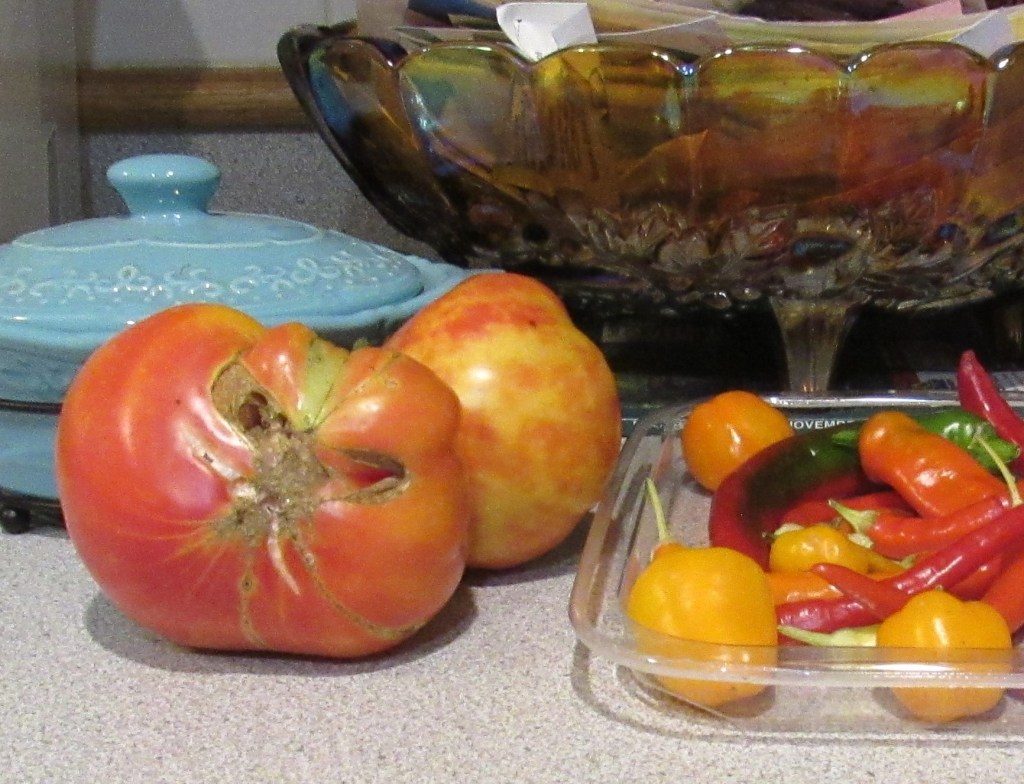
Finally, a true cat-faced tomato from my garden. And some of my pepper haul.




 Memories of a Midwestern Family