
Some information on my grandmother’s (Vera Alene Stewart, 1905-2003) antecedents.
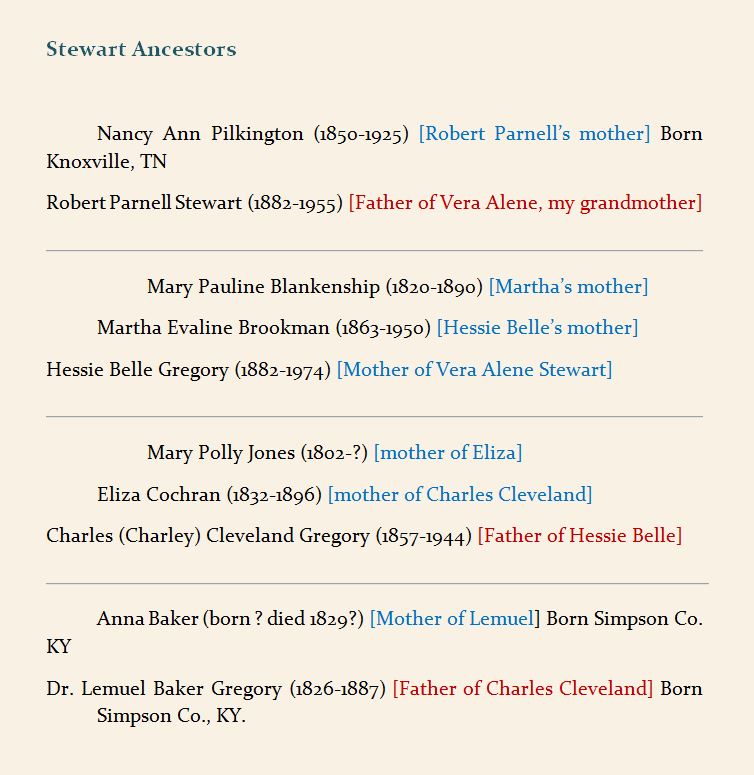
Genealogy
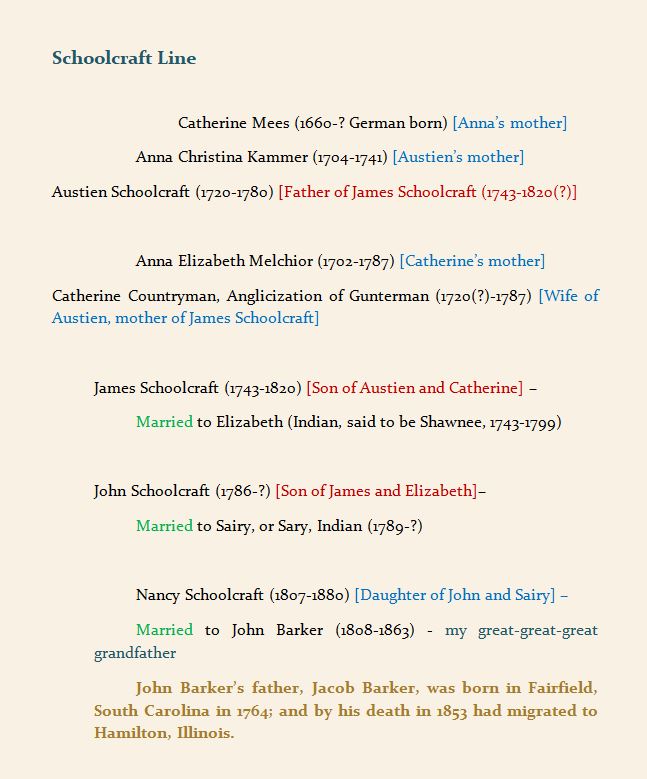
Schoolcraft Family Ties
A snippet from the Schoolcraft branch of the Barker line.
Bonus: My high school graduation get-up, 1979.

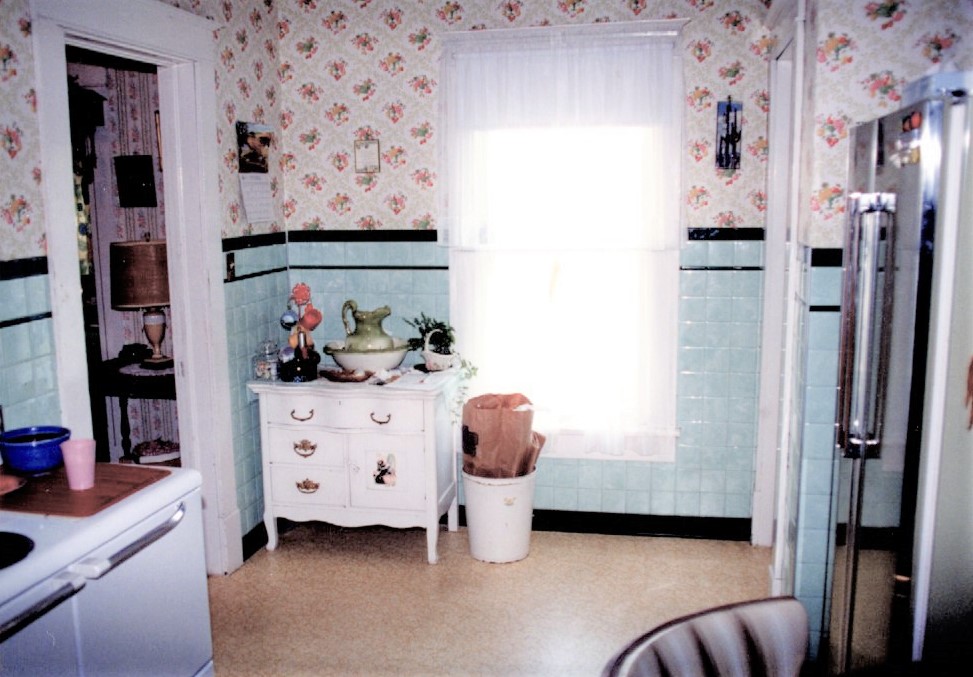
Nostalgic Pics

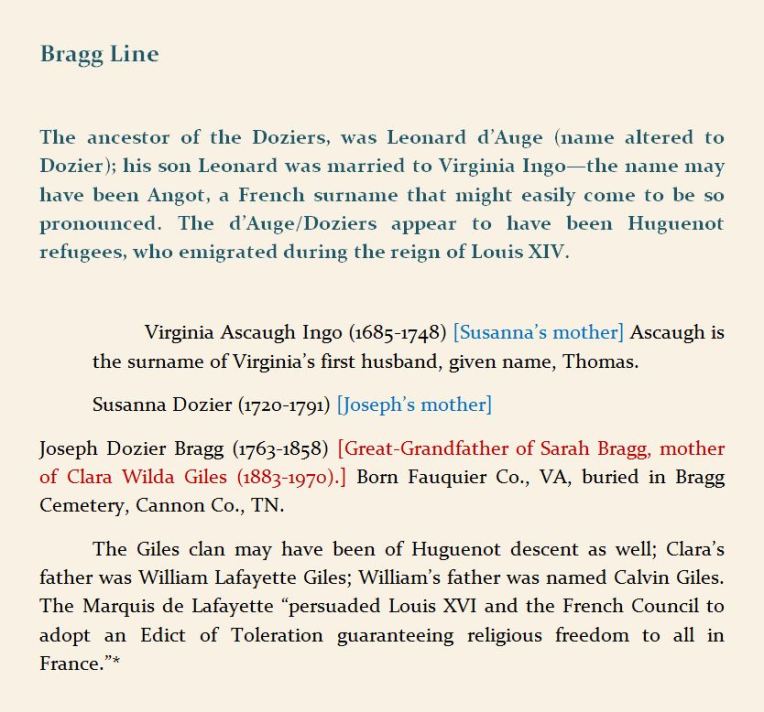
The Bragg Line
Some information on the Barkers, going back through the maternal line to colonial days.
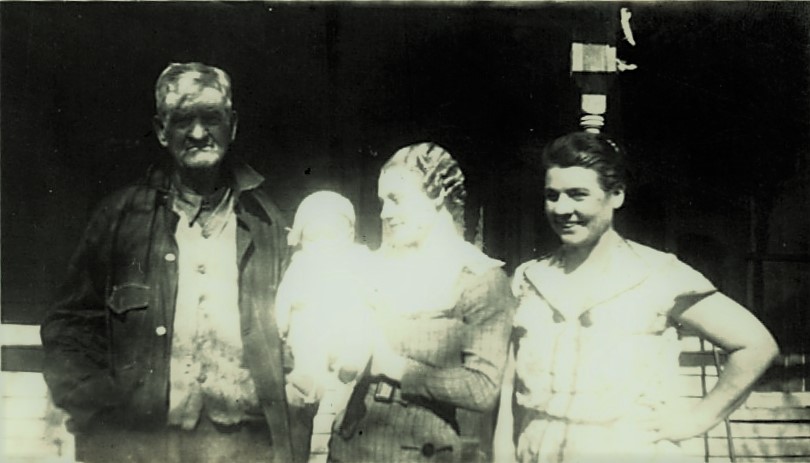
My Great-Great Grandfather
The text of C. C. Gaither’s (1858-1945) obituary.
Christopher Columbus Gaither, son of Silas and Miranda [Marinda] Gaither was born May 4, 1858, near Thompsonville, Illinois, and departed this life March 23 [1945], in the Moore hospital in Benton, Illinois, at the age of 86 years and 10 months and 19 days. He was united in marriage to Isabelle Adams Plasters, now deceased, in 1877 [1878]. To this union were born two children, Mrs. Dora McCollum, Akin, Illinois, Mrs. Effie Summers, Benton, Illinois.
In 1883, he was united in marriage to Mary J. Summers, also deceased. To this union were born 11 children, seven boys and four girls, namely, Millard, Portland, Oregon; Carter, Enumclaw, Washington; Ernest, Decatur, Illinois; Silas and Riley, Thompsonville, Illinois; Roy and Hobert, deceased; Mayme Burg, Sacramento, California; Fannie Brinker, Hot Springs, Arkansas; Mila Ramsey, Mt. Vernon, Illinois, and Marie, deceased.
In 1934, he was united in marriage to Florence Aiken. He spent his entire life in Franklin County, being a farmer until his retirement, when he moved to Akin, where he has lived for a number of years.
He will be sadly missed by his many friends and neighbors. He leaves to mourn his passing eight children, 26 grandchildren, 38 great-grandchildren, two great-great-grandchildren, one brother, Matthew Ing of Michigan, one sister, Paralee Summers, of Thompsonville.
He would not want the ones he loved
To grieve for him today
We must not say that he is dead
For he is just away
Away upon a journey
To a land that’s bright and fair
And though we will miss him here
We know he’s happy there
And memories will bring
New comforts every day
As we recall he’s not dead
But just away
Card of Thanks
We sincerely wish to thank our many friends and neighbors for their assistance during the death of our dear father, Columbus Gaither. We especially wish to thank those that gave the floral offerings and the Drake Funeral Home and Rev. C. C. Mitchell for his words of comfort—The Gaither Children.
Note:
Columbus Gaither’s death certificate lists the cause of death as accident; he was struck by a car while walking down the road near his home. The driver was a Summers, and may have been one of his relatives.
On Family Tree Info Safety

Obviously, this is the first concern, when we undertake to share our pictures, newspaper clippings, etc. What about internet predators?
The internet belongs to us, its users. The service providers exist, because we exist and use their products. So, if we had a users’ bill of rights, one article ought to be that we can have fun, we can show off our interests; we can be entertained; we can participate (in games, quizzes) without the harassment or paranoia of having to suppose the whole thing is a setup to steal our information.
Part of the problem, is that the problem is so difficult to quantify. One set of numbers gives the damage at 16 billion dollars stolen, and 15 million identities. But, not long ago a story came out that 700 million users’ information was included in a “data dump“, posted this past December. This represents, as authorities believe, an amalgamation of several breaches…so, are hackers making a thousand dollars a hit, or something less impressive, to the tune of about twenty or thirty dollars a hit?
Two trends account for much of the theft of information, and the money in these cases is made “in good time” through false representation of constituencies, both of the sort created to influence politics in election fraud, and the “followers” a web-based enterprise faking its popularity to boost its borrowing potential, may purchase from a hacker.
So what about your information? Well, for one thing, the times haven’t changed that much. In the 1950s, it would have been little trouble for someone to learn who lived at a particular address, or pick up maiden names and family tidbits from obituaries, and other news. More than that, as genealogists know, all sorts of personal information was published—and we’re glad of it—in those newspaper columns of old times, where citizens’ visits and club activities, family illnesses and engagements were itemized.
People can find these things out about you today, from any number of public sources. We don’t need a new mental affliction, in which we worry about telling our physical address, or even our email address, making evils in our mind with a runaway imagination, that only adds to the world’s mistrustfulness and division. We use these things every day, and must, to do business. It is the responsibility of banks, ISPs, social media, et al., to make their customers and users secure, not that of the users to block (by some means) doorways these entities hold open. Most major hacks have been attacks on servers.
Still, history buffs and genealogists, and writers looking for the milieu in which their stories will take place, and all others with good and innocent purposes (which are still the majority of people on the internet), be careful. Don’t use family names, pet names, children’s names, favorite songs, favorite movies, favorite colors, food, vacation sites, anything else you’ve already told the world about, to make passwords, or to answer security questions.
Hello! Memories is a Family Tree site

This new and growing site is dedicated to archiving and preserving research into the Foster and Barker lines of Southern Illinois.
 Memories of a Midwestern Family