News from 1819

Baby Deer
Photographed through the kitchen window, so as not to scare them. These two and their mother have been spending hours in my garden each day.


Transcriptions from the Alexandria Gazette and Daily Advertiser, September 1, 1819


The New Orleans Gazette of the 4th inst. states that a most dreadful hurricane took place on the coast of New Orleans, on the 28th ult. in which the U.S. schooner Firebrand, officers and crew were entirely lost; several others have met a similar fate or have been sunk. The officers on board the Firebrand were Lieutenant Grey, Dr. Wardle, and Messrs. Perkins and Adams, midshipmen. The schooner Thomas Shields was also capsized at the bay of St. Louis, and all the hands lost. All the houses at the bay of St. Louis were seriously damaged, and most of them blown down. The extent of the damage, it appears by the New Orleans Gazette, are as yet but partially known.

[The hurricane would have struck N.O. around July 28, 1819, the one reported below, striking the Virginia coast, was a separate event, of late August 1819]


The Weather

We do not recollect to have ever witnessed at this season of the year, a heavier fall of rain than we have had in this place within the last eight and forty hours. With very little intermission it poured a perfect torrent, from Thursday afternoon, about four o’clock, until nearly the same hour yesterday, blowing a heavy gale of wind the greater part of time from Northeast to West, shifting frequently. The sudden change of wind from the former to the latter point, on the first of the floodtide, checked the water passing up James River, and caused it to raise so high in this harbor that all the wharves were overflowed, and most of the warehouses contiguous had their lower floors covered from one and a half to two and a half feet. The damages sustained from this source is a little short of, if it does not succeed, 2 thousand dollars. Messrs. J. and W. Southgate, J. R. Harwood, W. Ashley, and S. & P. Christian are the principle sufferers, the three first by injury done to perishable articles in the lower story, and the last by the tide sweeping off a quantity of shingles from the end of Moran’s wharf. Spars, plank, heavy timber, and wharf logs were seen floating about in the harbor, and deposited in places on the wharf where they had been left at the recess of the tide.

Several vessels were driven on shore in different parts of the harbor, but, we believe, sustained no damage.

The wind blew with intense violence until about 5 o’clock yesterday evening; and when our paper was put to press the weather had not assumed any thing of a settled appearance.

We anticipate shocking accounts from such vessels on the coast as were unable to make a harbor before the gale set in. Our harbor is full of vessels that had put in in expectation of bad weather.


100 Dollars Reward


I will give the above reward to any person who will return to my possession, negro LAWRENCE, who assumes the surname of FENWICK. This fellow left my farm, on the Wicomico river, in Charles county, Md. on the 6th July, in consequence of his own outrageous conduct towards my overseer. He is a negro of a fine erect figure, good features, a smooth black skin, rather above the middle stature, of a youthful appearance for one of thirty years of age, and of great plausibility and natural smartness. His ears grow remarkably close to his head, and on the inside of his lower lip, he has a white mark or spot. I purchased him 4 years ago of the estate of Mrs. P. H. Courts, of this county. I am led (by circumstances which have come to my knowledge since he absconded) to believe that he will endeavor to make his way to King George county, Va.; should he not take this route, he will probably be met with in the District of Columbia, or in the upper counties of this state, on his way to Pennsylvania. I apprehend he will change his name, and if committed to jail, refuse to state to whom he belongs, as the misconduct which preceded his departure, & his absconding, have all appeared since to be premeditated. He took all his clothes with him, of which he had a large number; among them—a new bearskin overcoat, a long, close-bodied blue coat, a pair of striped jean pantaloons, one or more of white waistcoats, besides many articles of coarse clothing; these, however, he will probably exchange, or sell them for cash to defray his traveling expenses.

I will give the above reward to any person who will bring him home to me, or FIFTY DOLLARS if confined in jail, and notice given me, so that I recover him.

Should he be taken out of state, I will also pay all reasonable costs and charges which may attend the bringing him home.


I. T. STODDARD

West Hatton, near Allen’s Fresh Post Office, Charles county, Md.


Fifty Dollar Reward


 Ran away from the subscriber living in King George’s County, Va. on Monday the 22nd of March, a yellow man names JAMES, about 22 years of age, his fore-teeth wide apart and cannot speak very quick—had on Virginia cloth clothes and carried off a shaggy great coat, he has a father named Peter Hall, who lives with the widow Morgan at Oak Hill, Farquier Co., and his grandfather old Frederick Hall, is supposed to be living at Mr. Terrett’s near Alexandria, and it is likely he may be lurking about there. I will give the above reward for apprehending and securing said fellow so that I get him again, and reasonable charges if brought home.


J. H. WASHINGTON

Masters of vessels and others are forewarned against harboring or carrying off said fellow.


Look Here

All classes of citizens concerned for the welfare of their posterity and the community at large, are informed there has just been published an ornamental sheet, entitled an


Antidote for Dueling;


Containing the folly and wickedness of that practice, in forcible and energetic language; mostly selected from the sacred scriptures. They are to be had from the bookstores of Messrs. Davis and Force at Washington, and at the different bookstores in Alexandria.


Was Committed


To the jail for the county of Alexandria on the 28th ult., as a runaway, a mulatto man who calls himself JERRY MORE, and says he is free born, and that he served his time with a Mr. Francis White, living on Big Capon, Hampshire Co., Va. at Cold Stream Mills, and that he is recorded as a free man in the clerk’s office, at Romney, Va.  Said mulatto man is about 23 years of age, 6 feet high, stout and well made, has lost the first joint of the forefinger on his left hand.

The owner is desired to come prove property, pay charges, and take him away, otherwise, he will be disposed of as the law directs.


ANDW. ROUNSAVELL, Jailer


Missouri and Illinois Bounty Lands


The subscriber has for sale a number of the most valuable tracts, in both of those rich and improving bodies of lands, and can supply applicants with any number they may wish, and in any part of either territory. Every person who visits the Western Country, particularly those who intend settling there, should take with them a few quarter sections of those lands; every man who has a young and growing family, and can spare a few hundred dollars, should not miss the present opportunity of getting some of those lands; as it will insure to his children a greater certainty than any other type of investment he can possibly make for their benefit. From the immense emigration to both Illinois and Missouri, particularly to the military lands, it is certain there must be a great rise in the price very soon, and those who miss the present opportunity will never again have the chance to do so well. The patents will be sold very low, for cash, good notes, or bonds at short dates, or bank stock in the Central Bank of Georgetown and Washington, and the Farmers and Mechanics Bank of Georgetown. As I am a large dealer in Military Bounty Lands, I can supply any number that may be required.

Please reply at my Exchange Banking House, Bridge street, Georgetown.


ROMULUS RIGGS


(Source, U.S. Library of Congress)
 

Advertising of 1809

By 1809, newspapers had stopped using the “s” that looked like an “f”, and so are a little easier for 21st century citizens to read. Human beings for sale were mixed among other notices and advertisements. The United States was at strong odds with Great Britain, over the embargo and impressment practices of their war with Napoleon Bonaparte, that led to our war of 1812.

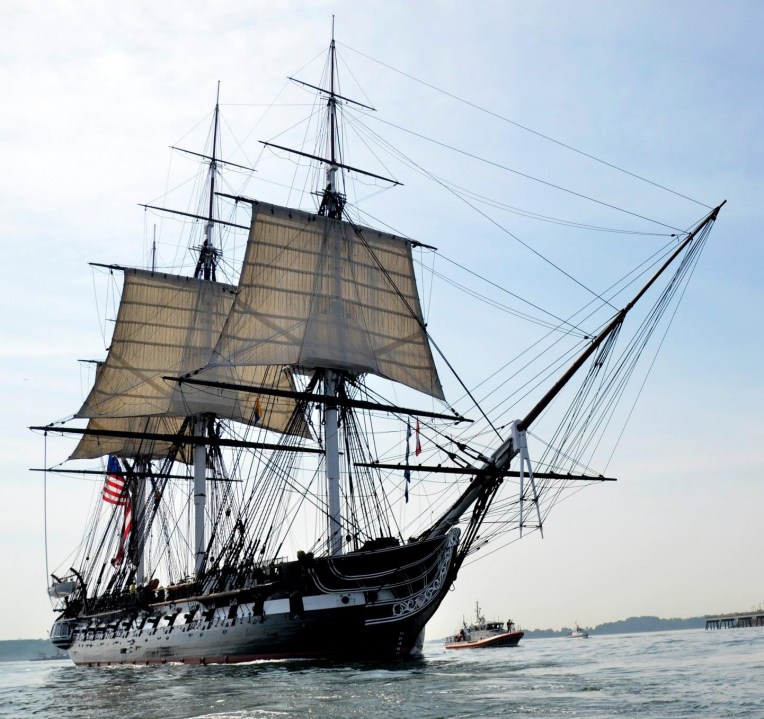
Photo of historic sailing ship USS Constitution
USS Constitution
The National Intelligencer and Washington Advertiser, March 3, 1809

Just Published

And to be had at R. C. Weightman’s Book Store

A tour through part of Virginia, in the summer of 1808, in a series of letters, including an account of Harper’s ferry, the natural bridge, the new discovery called Weir’s Cave, Monticello, and the different Medical Springs, hot and cold baths, visited by the author.

Price 37 and ½ cents


Mill Wrights Wanted

Six good journeymen will meet with employment by applying to the subscriber at Occoquin before the 20th March, and afterwards at Ellicott’s Lower Mills, 8 miles from Baltimore.


ONE HUNDRED DOLLARS REWARD

Ran away from the subscriber, in Pineataway, Prince Georges county, Maryland, on the 31st of May last, two Negro Men, viz. POMPEY, a very black man, upwards of 50 years old, 5 feet 10 or 11 inches high, rather slender made, with a small head and face; his forehead projects considerably over his eyes, and it is believed he has lost an under foretooth; he is much addicted to liquor, and when drunk disposed to talk a great deal; he has been accustomed to drive a carriage and waggon; he had on when he went away a deep blue short jacket of coarse cloth, oznabrig shirt and trowsers.

Basil, a dark mulatto, about 22 or 23 years old, 5 feet 8 or 9 inches high, rather stout made; has thick lips and large mouth; the forefinger of his right hand is stiff and smaller than the other; he had ulcers on his legs, and if healed, the scars may be discovered. Basil was a house servant, and at the time he went off, his apparel was the same as Pompey’s, but they had each a variety of cloths. They may endeavor to pass as freemen, and it is probable that Basil is in Alexandria or Baltimore, as his father is living in the former place, and he has a brother and sister in the latter. It is conjectured that a black man in the District of Columbia named Jack Neall, has contrived to get them away, as the subscriber has been informed that the said Neall about two years ago carried a negro woman of his on board a vessel at Alexandria, at which time she was a runaway. The above reward (including what the law allows) will be given for securing Pompey and Basil in any jail, so that the subscriber shall get them again, or Fifty Dollars for either and all reasonable expenses if brought home. All persons are forewarned against harboring them.

JACOB DUCKETT


WANTED TO PURCHASE

A Servant, accustomed to wait on a single gentleman, who is sensible and likely, and has a good character; for whom liberal price will be given.


FOR SALE

A very likely, healthy, MULATTO GIRL, about 12 years of age—apply at this office.


FOR SALE

A valuable family of NEGROES, consisting of a man, who is a carpenter, his wife and seven children; all young and healthy.

BENJ. ODEN

Prince Georges County


FIVE DOLLARS REWARD

LOST, a SILVER WATCH, with hands telling the day of the month, on the face of her, and capped—Mott, maker, of New York. Whoever will return the Watch to this office, shall receive the above sum, and no questions asked.

News of 1803

Photo of hollyhock bloom white with purple veins
From my garden this year, an extra-pretty hollyhock.
From The National Intelligencer and Washington Advertiser, January 24, 1803, U.S. Library of Congress
[A weekly feature, sampling the news and opinions our ancestors might have been reading.]


Message from the President of the United States

Gentlemen of the Senate, and of the House of Representatives


I enclose a report of the Secretary at War, stating the trading houses established in the Indian territories, the progress which has been made in the course of the last year, in settling and marking boundaries with the different tribes, the purchases of lands recently made from them, and the prospect of further progress in marking boundaries, and new extinguishments of title in the year to come, for which some appropriations of money will be wanting.

To this I have to add that when the Indians ceded to us the Salt Springs on the Wabash, they expressed a hope that we would so employ them as to enable them to procure there necessary supplies of salt. Indeed it would be the most proper and acceptable form in which the annuity could be paid which we propose to give them for the cession. These springs might at the same time be rendered eminently serviceable to our western inhabitants, by using them as a means of counteracting the monopolies of the supplies of salt, and of reducing the price in that country to a just level. For these purposes a small appropriation would be necessary to meet the first expenses, after which they should support themselves, and repay those advances. The springs are said to possess the advantage of being accompanied with a bed of coal.


TH: JEFFERSON

January 13, 1803


Note, above, our third president proposes as the best solution to paying the annuity the U.S. government owes the Indians who’d just ceded rights to the salt springs, giving them salt from the springs! 


[A conflagration in the city of Portsmouth, New Hampshire]


The late terrible fire with which Divine Providence has visited us, in a view of all circumstances, is believed to be without parallel in our common country. This town retarded in its early growth by many causes, seemed beginning to overcome those obstacles, when the revolutionary war, by its necessary effects, nearly annihilated its former and principal branches of Commerce. It was just emerging from this state; its trade began to revive and increase, and particularly in the central part of the town; where great exertions were made, and much money was laid out to render it commodious for the purpose, and even to embellish it.

This fair and beautiful part of the Town has in one short day become a heap of ashes and rubbish; exhibiting such a scene of devastation and ruin, as gives fresh pain at every new view. The number and value of the streets totally, or in a great measure destroyed— The number of inhabitants now exposed to sufferings and hardships, beyond the relief rendered by their sympathizing neighbors— The aged and infirm, widows and orphans unhoused in mid-winter— The stagnation of business, excepting the labor, patiently submitted to, and going on, of rearing or fitting up shelters for persons and property rescued from the flames— The great destruction of books, accounts, and papers of very great value— The inability of the inhabitants of the town, to preserve, without assistance, its trade with the interior, ready to fly off in many directions— And finally, the damages consequential to such a state of ruin, which, tho’ they may be conceived, baffle all description and calculation— ALL CONCUR to plead powerfully with the opulent and the prosperous; indeed with all in a comfortable state, who feel themselves exposed to like calamities, that relief is peculiarly desired and solicited— But injustice would be done to our own feelings, to those of our suffering friends and neighbors, to those of our benevolent fellow citizens in the union, did we not declare that the smallest donations which may be made by the compassionate of every class, will be gratefully received and with all others faithfully appropriated. This town has cheerfully had a fellow-feeling on like calamities taking place in distant parts of the union, and has no doubts of experiencing the sympathy it feels bound to shew.


JOHN LANGDON

DANIEL HUMPHREYS

JAMES SHEAFE

NATHANIEL ADAMS

JOHN GODDARD


Charleston, January 10

SOUTH CAROLINA BANK


A plan of the most daring nature to rob the vaults of this bank, was discovered during the night of Friday last and on Saturday morning. About three weeks ago a corporal of the city guard informed the porter of the bank, that while standing at the corner of the bank, he heard a noise of some person working under the ground or in the bank. Mr. Harvey, the deputy sheriff, having heard the same noise, gave the like information; but on examination, nothing of the kind being discovered, it was tho’t no more of; but on Friday night about eleven o’clock, Mr. M’Neil and his clerks, who live at the corner opposite the bank, observed a man lurking about the pavement next to the bank wall, who frequently stooped down to the pavement as if in the act of listening; struck by his conduct they went out, when the man made off. On examining the pavement, they found a brick loose and out of its place; supposing that this was the beginning of an attempt, they gave no alarm that night; in the morning, the place was again looked at, when the brick was found in its place, and some fresh earth spread over it. On taking up this brick, it was discovered that the earth below was taken away, or had caved in. On digging a little way down, a large vacancy was discovered, and some provision found lying at the bottom, also some tools by which the excavation had been made. Immediately after, the legs of a man were seen, who appeared to be desirous of retreating to the drain in the street, but was prevented, the earth that had fallen in having blocked up the passage. Convinced that he could not escape, he told those at work to unearth him, that if they would stop, he would deliver himself up, this being affected to, he came up, was apprehended and immediately committed to jail. On examination, his name is found to be William Withers, that he came to this city about a year past from Kentucky, that he had brought some horses, which he had disposed of, and spent the money. It is also known that during the last summer, he was very sick in this city, and being destitute of money, he had been obliged to lay in the Hay-Market of South Bay, he was there seen by a benevolent gentleman of this city, who had him removed to his house, had medical assistance given, and supported him until his recovery, he then suddenly disappeared; it is supposed that he then began the nefarious business he was detected in; he says that he entered the public drain of Church-street, near the French church, on the 10th of October last, and that he had been underground ever since, but from appearances it is believed he had progressed from the grating which is in the intersection of Broad and Church streets. At any rate he had worked through the palisade wall, and through the foundation of the bank, the latter of which is three feet and a half thick, this brought him to the wood cellar; a considerable quantity of wood here prevented his progress to the vaults, but it is believed, that had he not been discovered, he would have found means to remove this. He owns, which cannot be doubted, that he has accomplices. On Saturday a man named William Butner was apprehended about eight miles from the city; he is the man Mr. M’Neil and his clerks saw; another man, named Abner Robinson, has been committed by James Bentham, esq., who is charged with being an accomplice. As the court of session is to sit shortly, no doubt but it will be in our power to give a fuller account of this daring combination of villains.


(2019, Stephanie Foster)


Theme Songs


When I was growing up, we had a farm (a property with house and acreage, not a working farm) in Meigs County, Ohio. We went to play in the woods and fish, and be spooked by imaginary ghosts in the attic, on weekends. And whenever we came back on a Sunday evening, we’d have Canadian bacon sandwiches and watch these shows we loved. (Not so much, McCloud. But Columbo and McMillan and Wife.)


Some Pics from the Garden

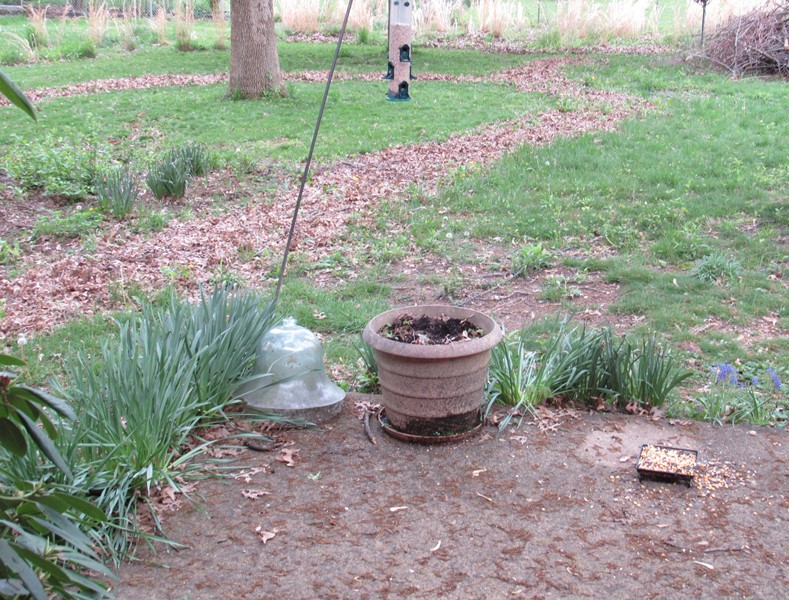
On my primary blog, I sometimes update readers about The Meadow Project. I am allowing a part of my yard to go semi-natural, with wild grasses and flowers. It all started with (aside from too much lawn to mow), noticing how few bees and butterflies I was seeing. Even the dandelions in the grass that always had one honeybee per flower, were just sitting empty. Here are some early to mid-spring shots of the latest developments.

This Red-tailed Hawk’s nest in the oak tree is why the squirrels are agog.

The paths I’m making with surplus leaves.

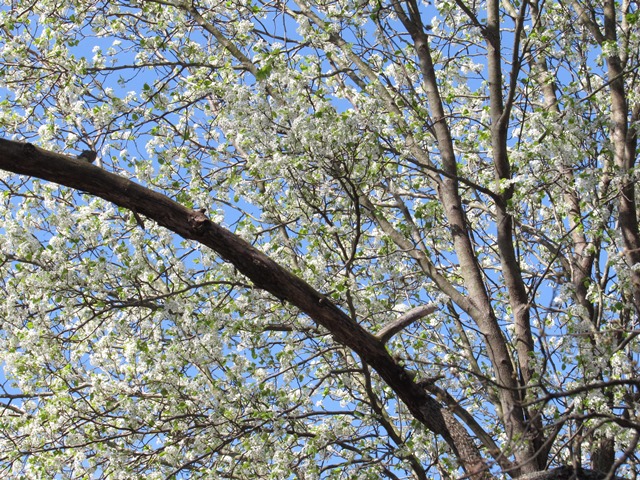
The pear tree, especially pretty in flower this year.

My seedlings, that I started late March. We keep having cold spells, so only the perennials can go into the garden.