The first street my family lived on in Athens (Ohio) was Grosvenor. The house was on a hillside, and had underneath, where the structure was built to overhang—so the house would sit more or less level—soft loamy dirt, that was always dry and made a place to play.
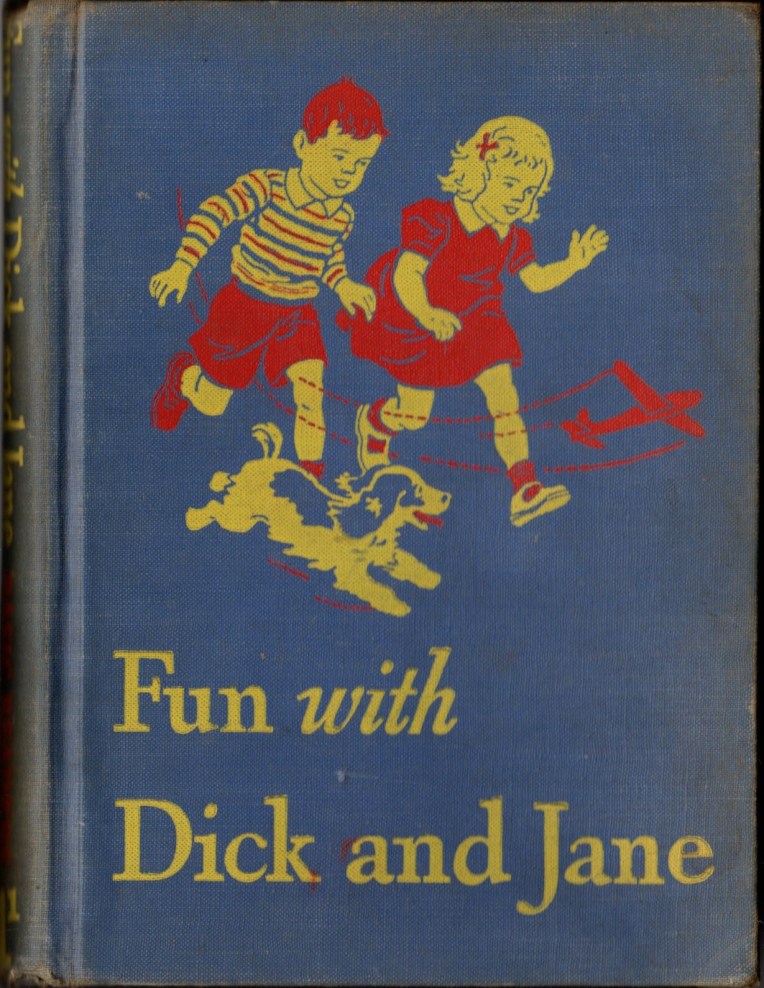
Since my grandparents had worked in the Mount Vernon, Illinois, public school system, we had a lot of old schoolbooks around the house. By the time I was in first grade, where kids began learning to read, I’d had a head start; and a lot of the reading I did was Dick and Jane. My first grade class had a Dick and Jane workbook; the characters in those days still in use for teaching.
They way we played pretend games, we had to choose who to identify with. I don’t recall if we specifically played Dick and Jane. I know we played Star Trek, a cool show that came on after bedtime, that we had to beg to watch. (My sister liked Chekov, and I had to be Captain Kirk, though I liked Riley, who was barely a character—because we had childish rules that two of us couldn’t like the same actor…but, readers, Mark Goddard all the way on Lost in Space, even though my sister claimed him. She let me have Colonel Foster on UFO. And note, the women on sci-fi shows didn’t get to do much, so it’s unsurprising in imagination we would rather have been the crew members allowed to explore planets.)
At any rate, in this hierarchy, I was the little sister, Sally. One of our cats of those days was named Puff.
And, coming full circle, I can recall marveling that the name pronounced “Grovner” could be spelled the way it was—but I wasn’t school age during the year or two we lived on that street. I think my sister was the one who could read the sign, and that was how I got the information, though I remember looking up at it and seeing the name in letters.
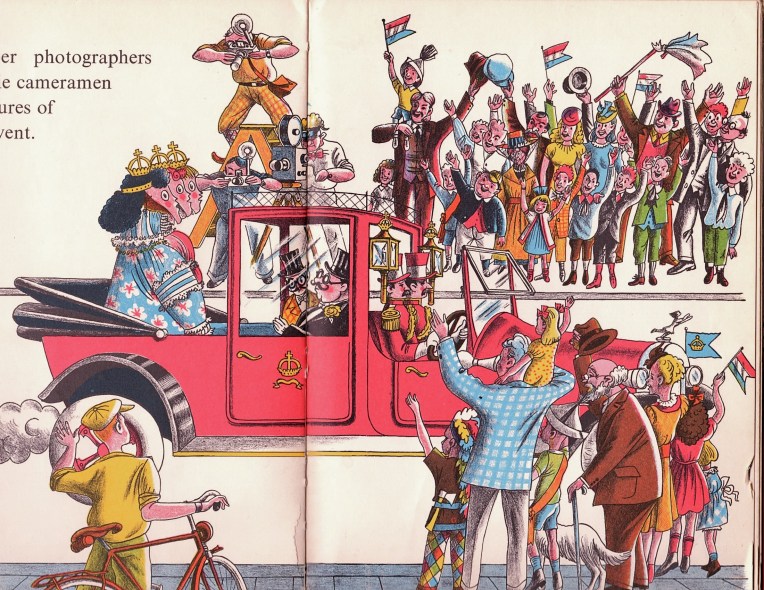
Here’s a page from one of my favorite books from childhood, Piet Worm’s Three Little Horses, a somewhat odd story about an artist who befriends horses, and takes them into town dressed as women—but a story terrifically illustrated.
Books in the Athens Middle School library
Favorite books some of you may remember. The first grouping were my own discoveries, and the second, books my sister read first and recommended. They are all look-upable, so I’ve written very brief descriptions of the plots.
Why Not Join the Giraffes, Hope Campbell, 1970
Girl tries to impress boy by adopting rebellious look.
The Whirling Shapes, Joan North, 1968
Girl has power to stop mysterious force.
The Apple Stone, Nicholas Stuart Gray, 1965
Siblings find magic object, adventures ensue.
The Power of Stars, Louise Lawrence, 1972
Visit by alien force causes havoc for teenage friends.
The Ghost of Opalina, Peggy Bacon, 1967
Family is aided through generations by cat’s ghost.
Campion Towers, John and Patricia Beatty, 1965
During English Civil War, girl on Roundhead side has cavalier adventures.
A Candle in Her Room, Ruth M. Arthur, 1966
Haunted doll causes trouble for newly arrived family.
My Darling My Hamburger, Paul Zindel, 1969
Pregnant teen gets abortion.
Knee-Deep in Thunder, Sheila Moon, 1967
Girl travels to tiny world, where her friends are insects.
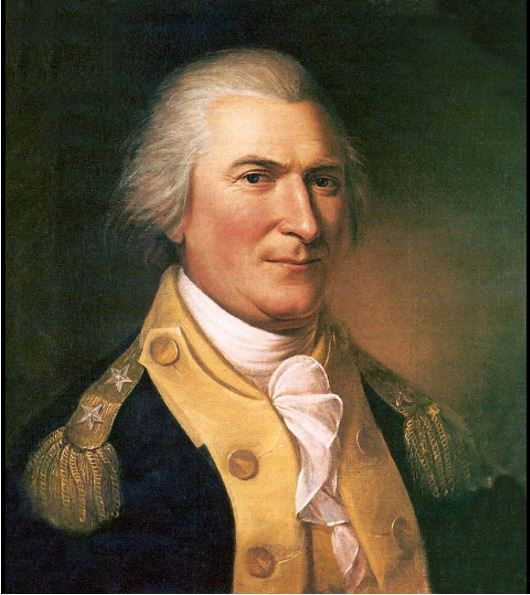
NW territory Governor Arthur St. Clair (public domain)
Vanderburgh County is the place of my birth, and so I share below some historical information on the man for whom the county is named. An additional note: Governor St. Clair, in his written opinions on slavery tended, as did many early leaders, to rely on English Common Law, and its well-known emphasis on property rights. He could be passionately in favor of states formed from the Northwest Territory being free, and yet fall back on the argument that laws can’t fairly obtain retroactively, a great truth in and of itself. But to claim that therefore, to emancipate slaves belonging to settlers in the territory prior to the Ordinance of 1787, would be unjust unless they received compensation—as would be correct in expropriation of actual property—is to use a narrow legal focus to evade confronting the higher injustice. This question rested on an ethical issue, one that must supersede any property claim, and nullify any representation of fair exchange. That slavery is inherently wrong, that human beings cannot be property, sat uneasily, in the political environment of post-colonial America, next to the notion that an infant government, to hold its power, must respect the individual rights of its citizens. And like many officials, the “fathers” seemed to have hoped attrition would solve the conflict.
In the summer of 1794, Judge Turner, who had gone to Vincennes to hold court, became involved in an extensive quarrel with Henry Vanderburgh, who was then probate judge and justice of the peace for Knox County, and Captain Abner Prior, of the United States Army, who was supervising Indian affairs on the Wabash. Several matters were in controversy and bitter feelings were produced. In the midst of this a negro and his wife, held as slaves by Vanderburgh, applied to Turner’s court for emancipation by writ of habeas corpus, instigated possibly by Turner. That Turner would have held that the ordinance* freed them is beyond question, for he expressly declared that they were “free by the Constitution of the Territory”, but before the cause came on for trial the negroes were seized and carried away by a party of men who, as Turner alleged, were employed by Vanderburgh. Turner then had the kidnappers arrested, though some of them resisted, and one threatened the sheriff with a knife. Complaints from all parties were made to St. Clair, who, though declining to adjust the difficulty, took sides against Turner and proceeded to give him some information as to the meaning of the Ordinance, which will be noticed later. The French settlers were greatly excited over this attempt to release their slaves. The grand jury of the county found a presentment against Turner, and later on, the citizens preferred charges against him which were submitted to Congress as grounds for impeachment, but, on the suggestion of the Attorney General, the House of Representatives recommended a trial in the courts as preferable.
Jacob Piatt Dunn, Indiana, A Redemption from Slavery, 1888, c. renewed 1905 and 1916.
Some years previous to these transactions Hugh McGary, a Kentuckian and a sturdy pioneer, had emigrated from his native state to the new territory and settled in what is now Gibson County. In 1812 he purchased from the government the land on which the city of Evansville now stands, and leaving his inland cabin pushed his way to the bank of the river and there established his home.
McGary’s place was not central, but when the commissioners appointed to make the selection were assembled at the old Anthony mill, he presented the claims of his location in the best light possible. It was not the first choice, but was finally selected. At the direction of the court of the new county, the town was laid out, and officially designated as Evansville, in honor of General Robert M. Evans, a distinguished soldier and citizen of Gibson County.
McGary became very enthusiastic over his prospects and confidently felt that his town was destined to be a metropolis at no very distant day. His hopes, however, rested on a weak foundation. By the formation of Posey county in the southwest corner of the territory the boundaries of Warrick county were so altered as to place Evansville at one extremity of its river border, and before the town was three months old, the legislature enacted, September 1st, 1814, that the seat of justice for the county should be moved to a place subsequently called Darlington, and situated some four miles above the present site of the neighboring town of Newburgh, and about one mile from the river.
In those days it mattered little what natural advantages a town possessed or what resources lay about it undeveloped; all its hope for prosperity was based upon its being the seat of justice for some county. The founder of the village set about with great zeal and industry to supply this desideratum. As the first step he enlisted the active interests of Gen. Robert M. Evans and James W. Jones, both of Gibson county, by conveying to them on June 20, 1817, for $1,300, 130 acres of land, being all that part of fractional section No. 30 which lies above the center of Main Street in Evansville, except thirty acres previously conveyed to Carter Beaman. On the 17th of July following, these three gentlemen, Evans, Jones, and McGary, prepared a plan for a town, ignoring that previously laid out. What they platted appears on the maps of the present time as the “original plan” and is bounded by Water and Third, and Chestnut and Division streets. The combined exertions of these three men were now set forth to accomplish the end already adverted to. The greatest obstacle to their success was the opposing influence of Col. Ratliff Boon, a man of more than ordinary ability, a courageous patriot and pioneer leader whose influence was not confined by the limits of his own county.
Enthusiastic and deeply in earnest in the contemplation of his favorite theme, Col. McGary did not allow his courage to weaken, and his complaints of Col. Boon were full of bitterness. His address was not displeasing, and his conversations on the subject of the ultimate greatness of his embryonic city, sparkling as they did with genuine ardor, were deeply interesting. About this time Gen. Joseph Lane, afterward of national repute, known as a wise and upright representative in the state legislatures, a hero of the Mexican war, a member of congress, and governor of Oregon, then a young man, figured in the drama beginning to be acted by becoming the means of bringing the weightier men together. Young Lane was engaged with others in rafting logs near Darlington, and floating them to Red Banks, where J. J. Audubon, later the foremost of American ornithologists, had erected, somewhat in advance of the times, a steam sawmill which afterward failed. When rowing back to his home, he stopped on the banks of the river near McGary’s house to spend the night, and then fell a victim to the enthusiastic and pleasing manner of the sanguine Colonel, walking with him over the site of the hoped-for city, then wild with forest trees and underbrush, hearing without resentment the bitter speeches of his companion against Col. Boon, whom Lane admired and counted among his best friends. Lane was soon afterward employed in the clerk’s office in Warrick county, and there suggested to Col. Boon the opportunity in his power of making valuable friends by assisting in the formation of a new county and yet leaving Warrick county large enough to serve his own purposes. Whether or not this suggestion brought the chief actors together, it is true that during the next session of the circuit court at Darlington, an informal conversation was held in the clerk’s office, which led finally to the consummation of McGary’s hopes.
The force of these arguments [in favor of dividing the territory into counties for jurisdictional efficiency] was conceded, the only objection being that Darlington would receive a fatal blow by such legislation, because the relocation of the seat of justice would necessarily follow. At length a plan satisfactory to all was agreed upon. It provided for the organization of two new counties with boundaries so fixed that Evansville and Rockport, then called Hanging Rock and not yet the site of a town, would be the most favorable points for the seats of justice. Darlington was to be left to continue its struggle for existence as best it could deprived of all public support.
In shaping these deliberations and leading to a conclusion, personal interest was doubtless a controlling factor. But be it said to the credit of the actors that private gain was not made at public expense, for great permanent good to the communities affected was the result.
Thus Vanderburgh county, as an organic unit, owes its existence more to the unyielding perseverance and untiring zeal of Hugh McGary in his efforts to maintain the village of Evansville, than to any other single agency.
It mattered little to McGary what name was given to the new county. If any was suggested or agreed upon in the conference which determined the question of its formation, it was abandoned for reasons of policy. Judge Henry Vanderburgh was worthy the honor conferred upon his memory, but he was in no way identified with the formation or development of the county.
History of Vanderburgh County, 1889 [compilation with no single author]. The paragraphs above are extractions of key information from a longer narrative.
The above selections have been lightly edited for punctuation.
This is an easy snack, just two cups of raw almonds, one tablespoon of mayonnaise, and 1/4 teaspoon of black pepper. Put the nuts in a bowl, stir in the mayonnaise and pepper until they’re all well-coated, then spread them on a baking sheet, and bake at 350 degrees. When they begin to brown, and smell a little like french fries, they’re done.
Today’s story is about TV movies, back when the movie-of-the-week was a big deal.
My sister Tracy and her friends were older, so they always had something they were into that came to me, the little sister trailing along, as sort of mysterious, since I was never there at the first discovery of it. Tracy was in middle school two years before I was, and in high school two years before I was.
So her gang knew this movie was going to be on TV, or they had all read that particular book. They were involved in Ohio University theater for a few years, as something like junior groupies. I don’t know who it was that opened the door for them; probably one of the sisters of her best friend from those days. One year the musical Carousel was a fascination, and the “older” man playing Billy Bigelow (a college student in his twenties) was a big crush. I think I saw him once (I picture him looking like Hugh Laurie with the hair of Art Garfunkel), but I don’t remember if I saw the show.
We were all singing “If I Loved You” and “What’s the Use of Wondering”, around the house.
A TV movie we were excited about seeing was called “A Howling in the Woods”. It aired in 1971, and starred Barbara Eden and Larry Hagman, also John Rubenstein, who I thought was very cute (look up his youthful pictures and you’ll agree), when he was in the TV show “Family”. I think, as to “Howling”, I never saw the whole thing, probably due to bedtime, but I remember the ads for this one, with Barbara Eden getting out of a car wearing a red hat, very glamorous.
“Brian’s Song”, also 1971, the football/cancer story starring Billy Dee Williams and James Caan. Truly a weeper, and we girls loved all the poignant things of the era, like the song “Honey” by Bobby Goldsboro, (1968), or “Seasons in the Sun”, Terry Jacks (1974).
Powell Kenzie has wandered, living the life of a vagabond, since his discharge from the army. The year is 1948. He finds himself in a small New England town, by watchman Lloyd Guy given temporary shelter in the remains of the Drybrook works. On the hill opposite sits the family’s empty house. Taken with an urge to settle, Powell conceives a plan to prove his usefulness. He meets Heinz Rohdl, a man seemingly insane. Then a visitor named Summers arrives to tell a ghost story.
Stories are from the American Watchman and Delaware Advertiser, October 15, 1824
Prince Saunders, a New England free black, through his public speeches and writings, led a movement under the protection of the Haitian king, Henry Cristophe (who had assumed the role, there being no hereditary royal line in Haiti, which rebelled from the control of France in 1791, and became independent in 1804). This movement attracted thousands of emigrants, but the dream of creating an economic base for free blacks with full equality of citizenship, was quashed by a fresh rebellion on the island.
The Time of a Black Boy
For Sale. He has been brought up in the country, on a farm, has six years to serve, and is stout and healthy. Inquire at the office of the Watchman.
[Contracts of apprenticeship could be bought and sold.]
What Next?
A short time since, an extraordinary operation was performed at the Kent and Canterbury hospital, upon a man whose sound thighbone was cut open, and an old decayed bone extracted. The man is now so much recovered as to be walking about the streets of Canterbury. We have now to record one almost as extraordinary, and which has been attended with the happiest results. A patient was received at the hospital some time since, with a very diseased liver. After some time, the case assumed the worst possible appearance, and it was resolved as the only chance of preserving life, to tap the liver. The operation was performed by Dr. Fitch, senior surgeon, in presence of other gentlemen of the faculty connected with the establishment. Upon the liver being touched, upwards of five pints of diseased matter immediately flowed from the wound. A tube, nine inches in length, was then introduced and retained in the wound, through which a pint of the same fluid was daily evacuated for a week! The poor man is getting quite well. Kent (Eng.) Herald
Emigration to Hayti
Emigration to Hayti is progressing with unexampled rapidity; it is not a mere experiment, but vessel after vessel is despatched.
The New York Evening Post of Tuesday says:
The ship Concordia is expected to sail this afternoon, or tomorrow morning, from this port for Hayti, with about 160 colored persons of both sexes. Six vessels at Philadelphia, one at Port Elizabeth, one at Alexandria, and several others at Baltimore, are on the eve of sailing for the same destination. It is calculated that between three and four thousand of these persons will leave the United States within a few days, and that every fortnight additional numbers will be shipped off under the direction of President Boyer’s agent, who pays the expense of their transmission by authority of the Haytian government. One hundred of those about to sail from this port, are from the state of New Jersey, and there can be no doubt that the great advantages held out will induce the mass of this part of our population to withdraw from the country.
Dept. of State
Washington 15 Sept. 1824
NOTICE
Citizens of the United States having Claims, under the Treaty of Ghent, for slaves and other private property, taken from them during the late war between the United States and Great Britain, are hereby notified, That the Definitive list, required by the subjoined article of the Convention of St. Petersburg, will be laid before the Joint Commission for ascertaining and determining the amount of such Claims, at its next meeting, in this City, on the 8th of December, in the present year; that such as have not already exhibited their Claims, and the evidences of them, to this Department, may do so before that time.
Article III
When the average value of slaves shall have been ascertained and fixed, the two commissioners shall constitute a board for the examination of the claims which are to be submitted to them, and they shall notify the Secretary of State for the United States, that they are ready to receive a definitive list of the slaves and other private property, for which the citizens of the United States claim indemnification: it being understood and hereby agreed that the commission shall not take cognizance of, nor receive, and that his Britannic Majesty shall not be required to make compensation for any claims for private property under the first article of the Treaty of Ghent, not contained in the said list. And his Britannic Majesty hereby engages to cause to be produced before the commission, as material towards ascertaining facts, all the evidence of which his Majesty’s government may be in possession, by returns from his Majesty’s officers, or otherwise, of the number of slaves carried away. But the evidence so produced, for its defectiveness, shall not go in bar of any claim or claims which shall be otherwise satisfactorily authenticated.
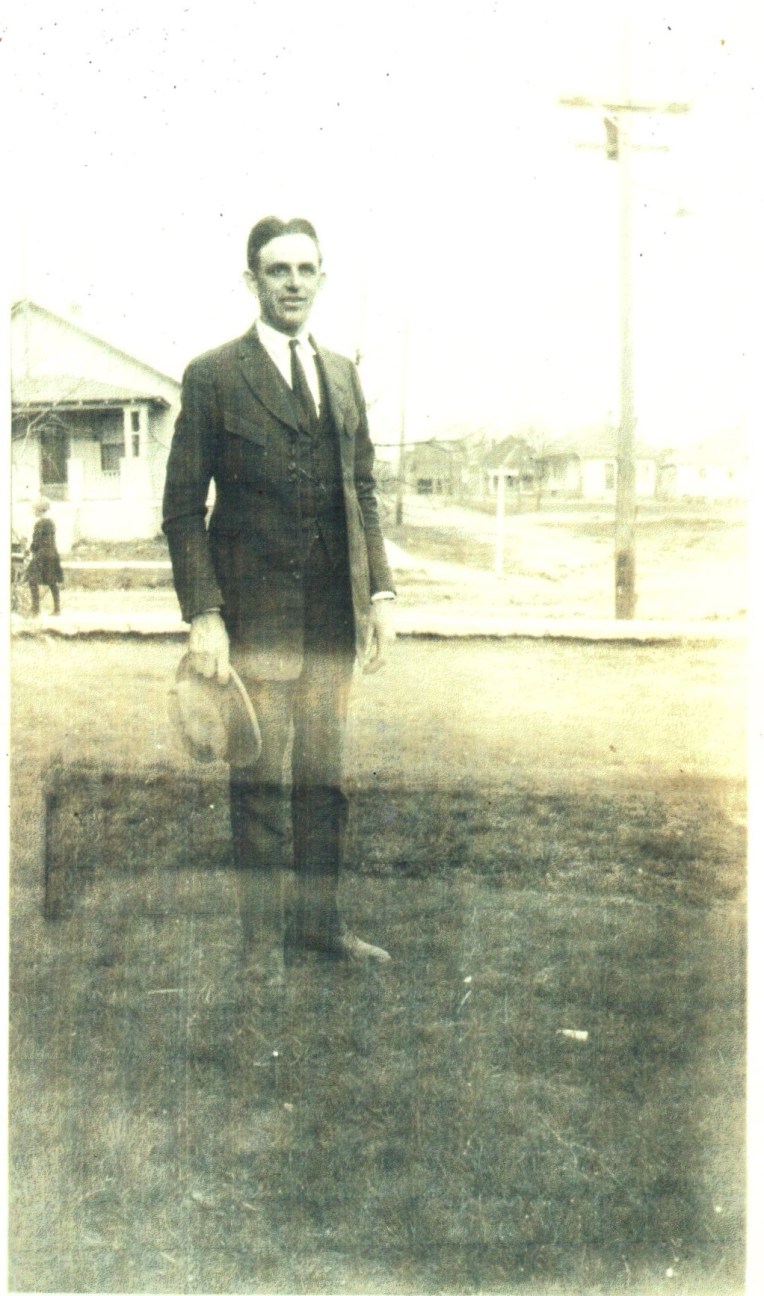
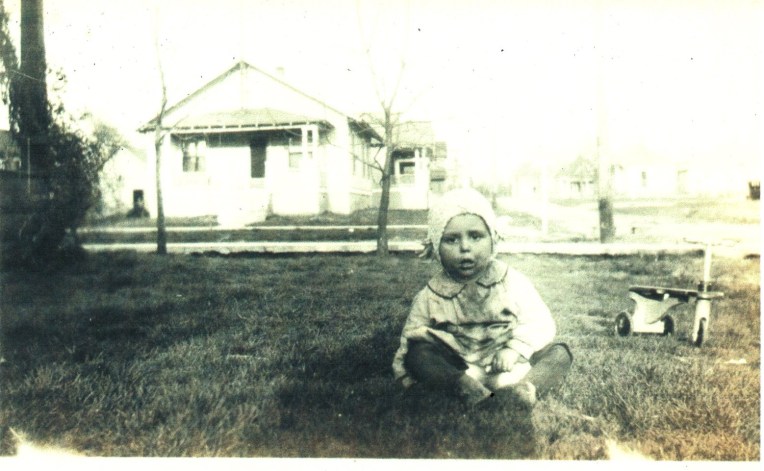
Below are two of my grandmother’s Brownie snapshots from the 1920s, taken on the back streets of Mount Vernon, Illinois. I don’t know who the subjects are, but both compositions have a sort of existential quality.
My G3 grandfather [Ramsey line], Silas Thomas Gaither (1832-1862) was married to Mary Marinda Clark (1842-?), who was the daughter of James Jordan Clark (1818-1897). James Jordan’s wife was Elizabeth Brewer. His own father was Edmond Clark, whose wife was Catherine Crane. The family at that time lived in Rutherford Co., NC.
From Lineage Book, The National Society of the Daughters of the American Revolution, 1906
Under listing for Mrs. Florence D. Foster Crowell, of Indianapolis, Indiana:
(Mrs. Crowell would be a connection, not in the direct line, but the common ancestor, William Foster II, was my direct ancestor.)
William Foster II, 1746-1809, served as corporal and sergeant of minutemen in Capt. Josiah Wood’s company, which marched on the Lexington Alarm. He was born in Walpole, died in Worcester County, Mass. [married to Abigail Chapin 1748-1786]
William was the father of Jonathan Foster, who was the father of Jared Foster, who was my G3 grandfather.
Almost Good for You, and Much Lighter than Cheesecake
This pie is made with Greek zero-fat yogurt, and does a convincing cheesecake imitation.
You’ll need a 32oz container of yogurt. Make sure it’s the zero-fat kind. I use vanilla, which has some sweetening, and a little extra flavor. Next, get a large mixing bowl, and add two cups of confectioners sugar, plus one-half cup of cocoa. Sift these together well, then add the yogurt. The dry and wet ingredients should blend together smoothly.
Crack five eggs and scramble them; pour them into your bowl and stir thoroughly into the mix.
Use a deep dish pie plate, and pour the filling over any crust you prefer. I use almonds I grind in my blender, but Graham cracker or Oreo would do well too.
I put the oven at 350, and advise checking for the surface to show uniformly matte, as to doneness. This is basically a custard, so if a small part in the center looks shiny, turn off the oven anyway before the sides get over-baked, and the residual heat will finish it.
And that’s it! Cool on the counter, and refrigerate when the pie is close enough to room temperature that it won’t “weep” under plastic wrap.
Me (Stephanie), on the left, my sister Tracy on the right. I don’t know how old I am in this picture…one or two years.
And, a few announcements from the year 1820, transcriptions I make to give family tree aficionados a taste of what their ancestors might have been influenced by, or talking about.
The Hillsborough Recorder (NC) August 16, 1820
The governor of Virginia offers a reward of $500.00 for George Hamblet, who committed a deliberate murder on a negro man, his slave, accompanied by circumstances of the most savage cruelty.
It is said, that the following gives the respective ages of the surviving political patriarchs who signed the Declaration of Independence:
William Floyd, of New York….87
John Adams, of Massachusetts….85
Thomas Jefferson, of Virginia….83
Charles Carroll, of Maryland….82
Gentlemen are requested not to kill a belled buzzard, which is ranging about this neighbourhood. It was belled at Yankee Hall in May last.
William W. Hall
Alexandria Gazette and Daily Advertiser, July 22, 1820
Liver Stable
Elizabeth Towers
RETURNS her sincerest thanks to the public for the liberal encouragement her late deceased husband received in the above business for this twenty years, and informs his friends and the public in general, that she still continues the above business at the former stand, where every attention will be paid that formerly was, to render ample satisfaction to those Ladies and Gentlemen that will honor me with their custom, as she has a large family to support, and through no other means.
Notice
PROPOSALS will be received at Fort Washington until June 20th for supplying the troops and laborers with FRESH BEEF twice a week for one year.
R. B. Lee, Lt. U.S.A.
A Card
Those ladies and gentlemen who witnessed the great exertions of Mr. and Master Napey to entertain them by the ascension of their balloon, and who were prevented by the crowd from approaching the old gentleman to contribute their mite to remunerate him, are respectfully invited to call at his place of abode, at the corner of Prince and Fairfax, to enable him to proceed to his friends at New York.
Mr. Napey takes this occasion to return his thanks to the citizens of Alexandria for their great kindness and liberality to him during his stay in town, and regrets that some untoward circumstances prevented him from fully executing his plan as it regarded his balloons yesterday.
(A novella; this volume also contains the short story “Are You Jealous”)
A sojourn in St. Petersburg creates an odd resonance for Minta Castelberry, touring this most European of Russian cities, with her mother-in-law. The women are accosted by an insinuating stranger. John Emmett insists on telling his story, and Minta soon finds that his arrogance hides a melancholy soul…and finds herself invested in his quest. Then she finds this crossing of paths is no coincidence.






 Memories of a Midwestern Family