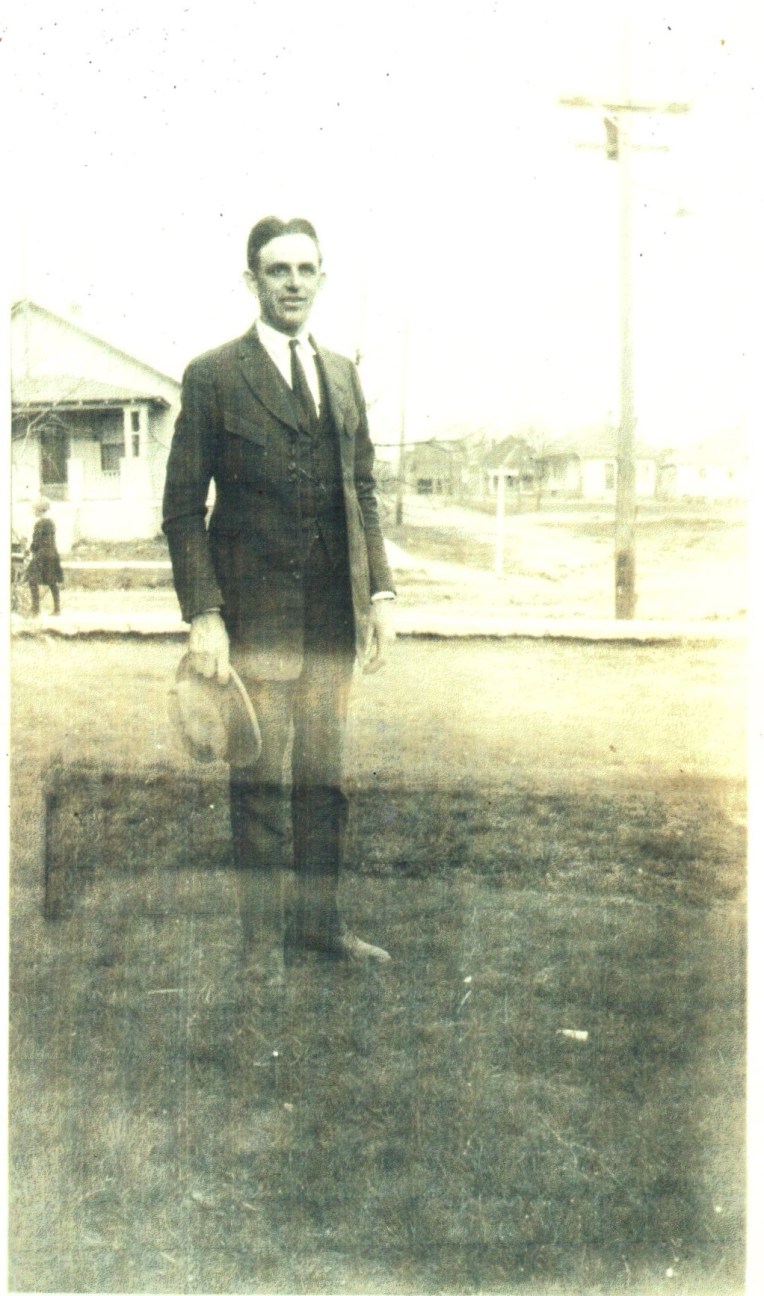
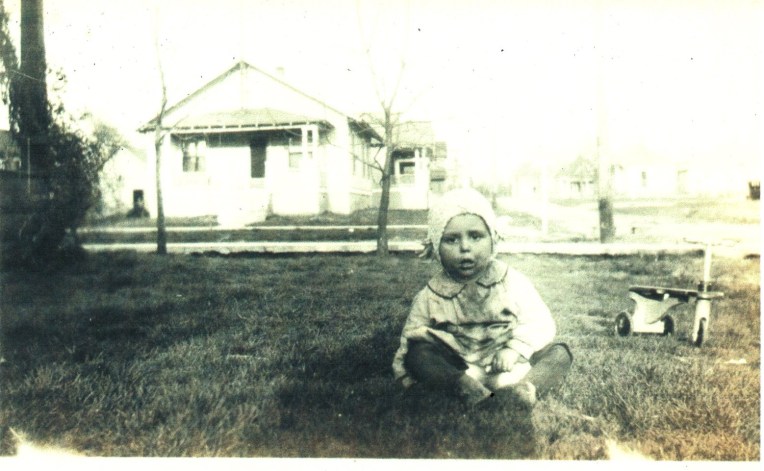
Below are two of my grandmother’s Brownie snapshots from the 1920s, taken on the back streets of Mount Vernon, Illinois. I don’t know who the subjects are, but both compositions have a sort of existential quality.
My G3 grandfather [Ramsey line], Silas Thomas Gaither (1832-1862) was married to Mary Marinda Clark (1842-?), who was the daughter of James Jordan Clark (1818-1897). James Jordan’s wife was Elizabeth Brewer. His own father was Edmond Clark, whose wife was Catherine Crane. The family at that time lived in Rutherford Co., NC.
From Lineage Book, The National Society of the Daughters of the American Revolution, 1906
Under listing for Mrs. Florence D. Foster Crowell, of Indianapolis, Indiana:
(Mrs. Crowell would be a connection, not in the direct line, but the common ancestor, William Foster II, was my direct ancestor.)
William Foster II, 1746-1809, served as corporal and sergeant of minutemen in Capt. Josiah Wood’s company, which marched on the Lexington Alarm. He was born in Walpole, died in Worcester County, Mass. [married to Abigail Chapin 1748-1786]
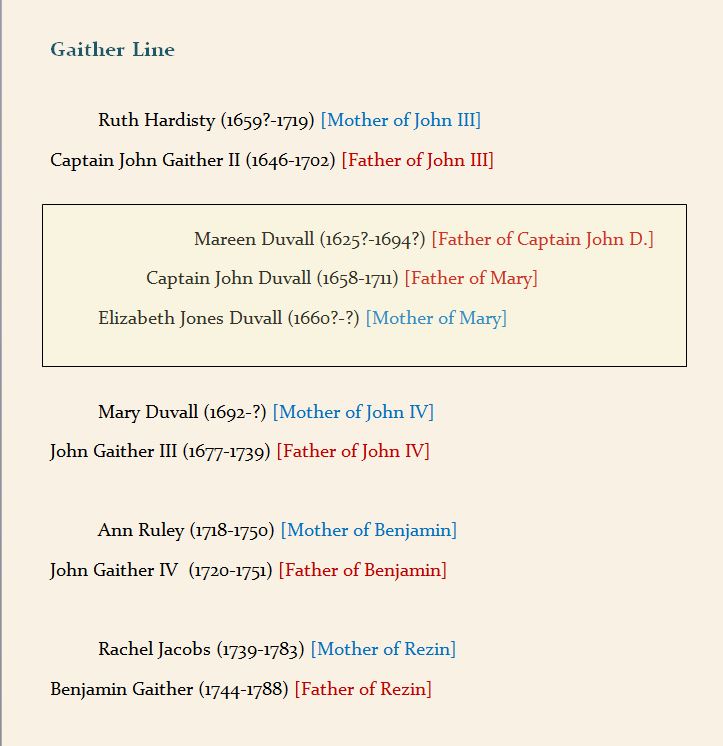
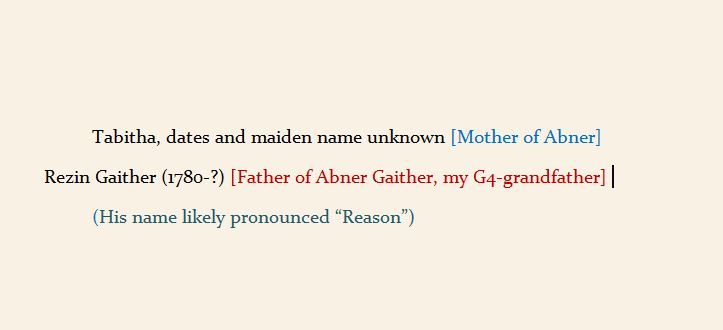
William was the father of Jonathan Foster, who was the father of Jared Foster, who was my G3 grandfather.
(A novella; this volume also contains the short story “Are You Jealous”)
A sojourn in St. Petersburg creates an odd resonance for Minta Castelberry, touring this most European of Russian cities, with her mother-in-law. The women are accosted by an insinuating stranger. John Emmett insists on telling his story, and Minta soon finds that his arrogance hides a melancholy soul…and finds herself invested in his quest. Then she finds this crossing of paths is no coincidence.
Most of my growing-up years, my family lived on Shannon Avenue in Athens, Ohio. Early on, when my parents first bought the house, a little cache of some former owner’s WWII souvenirs was found in the attic. My sister got to add to her things an “Aussie” hat, a cool article to play dress-up with. I got to keep these two items, the soldier’s campaign medal and a 1945 franc—a significant issue, after the country got its own government back. I would agree with anyone who feels we should not have had these things to play with, but seventy-four years on, I don’t know if the rightful descendants can ever be located.
Above, my cats at play, and a little accompanying music.
This is my latest book of poetry, which you can get on Kindle or as a paperback.
This squirrel with the red tail was part of my yard’s population for a while. But, I have hawks…
Mary Osgood Confession
My Foster ancestors settled in Massachusetts, some in the town of Salem. I don’t know that I have any direct descendancy from those involved in this famous event. But the Foster name comes up. As the story below relates, Mary Osgood was charged with tormenting a Rose Foster; also among the victims of this early hysteria was an Ann Foster, who died in jail. I feel the topic is worth a few analytical paragraphs. After all, the victims are often casually referred to as the “Salem witches”.
There is a strange sort of transmogrification, where feminism and political correctness join to color the story. Witches somehow, within our culture, much fueled by TV shows and books, are used to represent a kind of female power. The idea of the witch becomes iconic. At the same time, the notion of a protected class, a marginalized minority (and American history is rich in the marginalizing of minorities), gets woven in.
And what happens to justice?
An important lesson, for the times we live in, falls by the wayside. These people were not witches, a thing that doesn’t exist (while we make allowance for adopted religious practices). So we can’t “champion” their cause, by superimposing onto it pop culture and political creeds, resulting in an odd presumption of guilt. Our ancestors would not have wished to be told, “You’re a witch, and that’s okay!” They would have asked that their innocence be shouted from the rooftops.
Thus, the salient point, about application of the legal process: the case was not prosecutable. It would have been necessary to determine the validity of the charges first, before undertaking to bring them. The trials preceded on a circular basis: People made accusations against individuals; due to those accusations, the accused were brought to trial, to have the charges “proven” by the testimony of the accusers. There is a present danger of the same sorts of proceedings; and a bandying about, lately, of the term “witch hunt”. The fantasies the Salem accusers indulged were a product of those things culturally available to them; nothing unimaginable occurred, even in their heads.
So let’s bear this in mind—in the world of fiction, witches can be admirable characters, and carry the role of empowered feminist icon, or beleaguered minority, or both. The accused of Salem were ordinary people, innocent of the charges made against them, and murdered by the system.
The examination and confession (September 8, 1692) of Mary Osgood, wife of Capt. Osgood, of Andover, taken before John Hawthorne and Majesties’ justices. She confesses, that about eleven years ago, when she was in a melancholy state and condition, she used to walk abroad in her orchard; and upon a certain time she saw the appearance of a cat at the end of the house, which she yet thought was a real cat. However, at that time it diverted her from praying to God, and instead thereof she prayed to the devil, about which time she made covenant with the devil, who, as a black man, came to her and presented her with a book, upon which she laid her finger, and that left a red spot; and that upon her sinning the devil told her he was her god and that she should serve and worship him; and she believes she consented to it. She says further, that about two years ago she was carried through the air in company with Deacon Frye’s wife, Ebenezer Barker’s wife, and Goody Tyler, to Five Mile Pond, where she was baptized by the devil, who dipped her face in water, made her renounce her former baptism, and told her she must be his, soul and body, forever, and that she must serve him, which she promised to do.
She says the renouncing of her first baptism was after her dipping, and that she was transported again through the air in company with the aforenamed persons, in the same manner as she went, and believes they were carried upon a pole.
Q. How many persons were on the pole?
A. As I have said before; viz.: four persons and no more, but whom she had named above. She confesses she has afflicted three persons: John Sawdy, Martha Sprague and Rose Foster; and that she did it by pinching her bedclothes and giving consent, the devil should do it in her shape, and that the devil could not do it without her consent. She confesses the afflicting persons in the court by the glance of the eye. She says, as she was coming down to Salem to be examined, she and the rest of the company stopped at Mr. Phillip’s to refresh themselves up, and the afflicted persons, being behind them on the road, came just as she was mounting again, and were then afflicted and cried out upon her, so that she was forced to stay until they were all passed, and said she only looked that way towards them.
Q. Do you know the devil can take the shape of an innocent person and afflict?
A. I believe he cannot.
Q. Who taught you this way of witchcraft?
A. Satan; and that he taught her abundance of satisfaction and quietness in her future state, but never performed anything, and that she has lived more miserably and more discontented than ever before. She confesses further that she herself, in company with Goody Parker, Goody Tyler and Goody Dean, had a meeting at Moses Tyler’s house last Monday night, to afflict, and that she and Goody Dean carried the shape of Mr. Dean, the minister, between them, to make persons believe that Mr. Dean was afflicted.
Q. What hindered you from accomplishing what you intended?
A. The Lord would not suffer it so to be; that the devil should afflict in an innocent person’s shape.
Q. Have you been at any other witch meetings?
A. I know nothing thereof, and I shall answer in the presence of God and his people, but said that the black man stood before her and told her that what she had confessed was a lie; notwithstanding she said that what she had confessed was true, and thereto put her hand. Her husband, being present, was asked if he judged his wife to be any way discomposed. He answered that, having lived with her so long, he doth not judge her to be any way discomposed, but has cause to believe what she has said is true. When Mistress Osgood was first called, she afflicted Martha Sprague and Rose Foster by the glance of her eyes, and recovered them out of their fits by the touch of her hand. Mary (Foster) Lacey and Betty Johnson and Hannah Part [probably Post] saw Mistress Osgood afflicting Sprague and Foster. The said Hannah Post and Mary Lacey and Betty Johnson, Jun., and Rose Foster and Mary Richardson were afflicted by Mistress Osgood in the time of their examination and recovered by her touching of their hands.
‘I’ underwritten, being appointed by authority to take this examination, do testify upon oath, taken in court, that this is a true copy of, the substance of it, to the best of my knowledge, January 5, 1692-3. The above Mary Osgood was examined before their majesty’s justices of the peace in Salem.
John Higginson, Just. Pac.
Source: Foster Genealogy, Frederick Clifton Pierce, 1899.
(Mary Osgood was released, and died in 1710; the John Hawthorne mentioned, was the G2 grandfather of author Nathaniel Hawthorne.)
From my garden this year, an extra-pretty hollyhock.
From The National Intelligencer and Washington Advertiser, January 24, 1803, U.S. Library of Congress
[A weekly feature, sampling the news and opinions our ancestors might have been reading.]
Message from the President of the United States
Gentlemen of the Senate, and of the House of Representatives
I enclose a report of the Secretary at War, stating the trading houses established in the Indian territories, the progress which has been made in the course of the last year, in settling and marking boundaries with the different tribes, the purchases of lands recently made from them, and the prospect of further progress in marking boundaries, and new extinguishments of title in the year to come, for which some appropriations of money will be wanting.
To this I have to add that when the Indians ceded to us the Salt Springs on the Wabash, they expressed a hope that we would so employ them as to enable them to procure there necessary supplies of salt. Indeed it would be the most proper and acceptable form in which the annuity could be paid which we propose to give them for the cession. These springs might at the same time be rendered eminently serviceable to our western inhabitants, by using them as a means of counteracting the monopolies of the supplies of salt, and of reducing the price in that country to a just level. For these purposes a small appropriation would be necessary to meet the first expenses, after which they should support themselves, and repay those advances. The springs are said to possess the advantage of being accompanied with a bed of coal.
TH: JEFFERSON
January 13, 1803
Note, above, our third president proposes as the best solution to paying the annuity the U.S. government owes the Indians who’d just ceded rights to the salt springs, giving them salt from the springs!
[A conflagration in the city of Portsmouth, New Hampshire]
The late terrible fire with which Divine Providence has visited us, in a view of all circumstances, is believed to be without parallel in our common country. This town retarded in its early growth by many causes, seemed beginning to overcome those obstacles, when the revolutionary war, by its necessary effects, nearly annihilated its former and principal branches of Commerce. It was just emerging from this state; its trade began to revive and increase, and particularly in the central part of the town; where great exertions were made, and much money was laid out to render it commodious for the purpose, and even to embellish it.
This fair and beautiful part of the Town has in one short day become a heap of ashes and rubbish; exhibiting such a scene of devastation and ruin, as gives fresh pain at every new view. The number and value of the streets totally, or in a great measure destroyed— The number of inhabitants now exposed to sufferings and hardships, beyond the relief rendered by their sympathizing neighbors— The aged and infirm, widows and orphans unhoused in mid-winter— The stagnation of business, excepting the labor, patiently submitted to, and going on, of rearing or fitting up shelters for persons and property rescued from the flames— The great destruction of books, accounts, and papers of very great value— The inability of the inhabitants of the town, to preserve, without assistance, its trade with the interior, ready to fly off in many directions— And finally, the damages consequential to such a state of ruin, which, tho’ they may be conceived, baffle all description and calculation— ALL CONCUR to plead powerfully with the opulent and the prosperous; indeed with all in a comfortable state, who feel themselves exposed to like calamities, that relief is peculiarly desired and solicited— But injustice would be done to our own feelings, to those of our suffering friends and neighbors, to those of our benevolent fellow citizens in the union, did we not declare that the smallest donations which may be made by the compassionate of every class, will be gratefully received and with all others faithfully appropriated. This town has cheerfully had a fellow-feeling on like calamities taking place in distant parts of the union, and has no doubts of experiencing the sympathy it feels bound to shew.
JOHN LANGDON
DANIEL HUMPHREYS
JAMES SHEAFE
NATHANIEL ADAMS
JOHN GODDARD
Charleston, January 10
SOUTH CAROLINA BANK
A plan of the most daring nature to rob the vaults of this bank, was discovered during the night of Friday last and on Saturday morning. About three weeks ago a corporal of the city guard informed the porter of the bank, that while standing at the corner of the bank, he heard a noise of some person working under the ground or in the bank. Mr. Harvey, the deputy sheriff, having heard the same noise, gave the like information; but on examination, nothing of the kind being discovered, it was tho’t no more of; but on Friday night about eleven o’clock, Mr. M’Neil and his clerks, who live at the corner opposite the bank, observed a man lurking about the pavement next to the bank wall, who frequently stooped down to the pavement as if in the act of listening; struck by his conduct they went out, when the man made off. On examining the pavement, they found a brick loose and out of its place; supposing that this was the beginning of an attempt, they gave no alarm that night; in the morning, the place was again looked at, when the brick was found in its place, and some fresh earth spread over it. On taking up this brick, it was discovered that the earth below was taken away, or had caved in. On digging a little way down, a large vacancy was discovered, and some provision found lying at the bottom, also some tools by which the excavation had been made. Immediately after, the legs of a man were seen, who appeared to be desirous of retreating to the drain in the street, but was prevented, the earth that had fallen in having blocked up the passage. Convinced that he could not escape, he told those at work to unearth him, that if they would stop, he would deliver himself up, this being affected to, he came up, was apprehended and immediately committed to jail. On examination, his name is found to be William Withers, that he came to this city about a year past from Kentucky, that he had brought some horses, which he had disposed of, and spent the money. It is also known that during the last summer, he was very sick in this city, and being destitute of money, he had been obliged to lay in the Hay-Market of South Bay, he was there seen by a benevolent gentleman of this city, who had him removed to his house, had medical assistance given, and supported him until his recovery, he then suddenly disappeared; it is supposed that he then began the nefarious business he was detected in; he says that he entered the public drain of Church-street, near the French church, on the 10th of October last, and that he had been underground ever since, but from appearances it is believed he had progressed from the grating which is in the intersection of Broad and Church streets. At any rate he had worked through the palisade wall, and through the foundation of the bank, the latter of which is three feet and a half thick, this brought him to the wood cellar; a considerable quantity of wood here prevented his progress to the vaults, but it is believed, that had he not been discovered, he would have found means to remove this. He owns, which cannot be doubted, that he has accomplices. On Saturday a man named William Butner was apprehended about eight miles from the city; he is the man Mr. M’Neil and his clerks saw; another man, named Abner Robinson, has been committed by James Bentham, esq., who is charged with being an accomplice. As the court of session is to sit shortly, no doubt but it will be in our power to give a fuller account of this daring combination of villains.
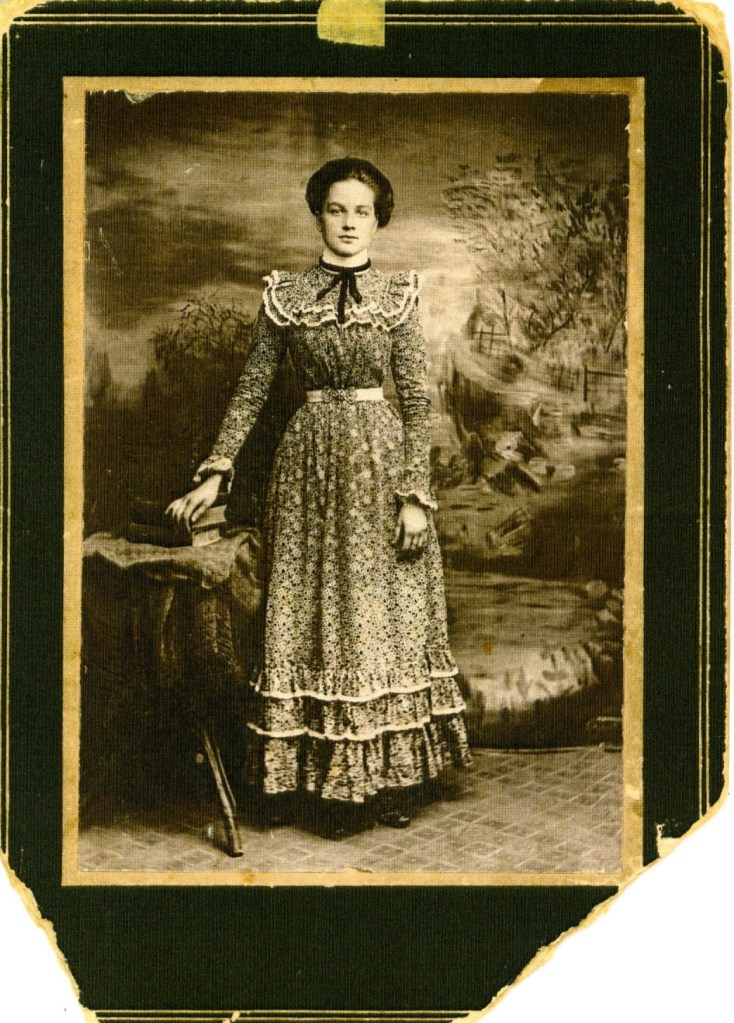
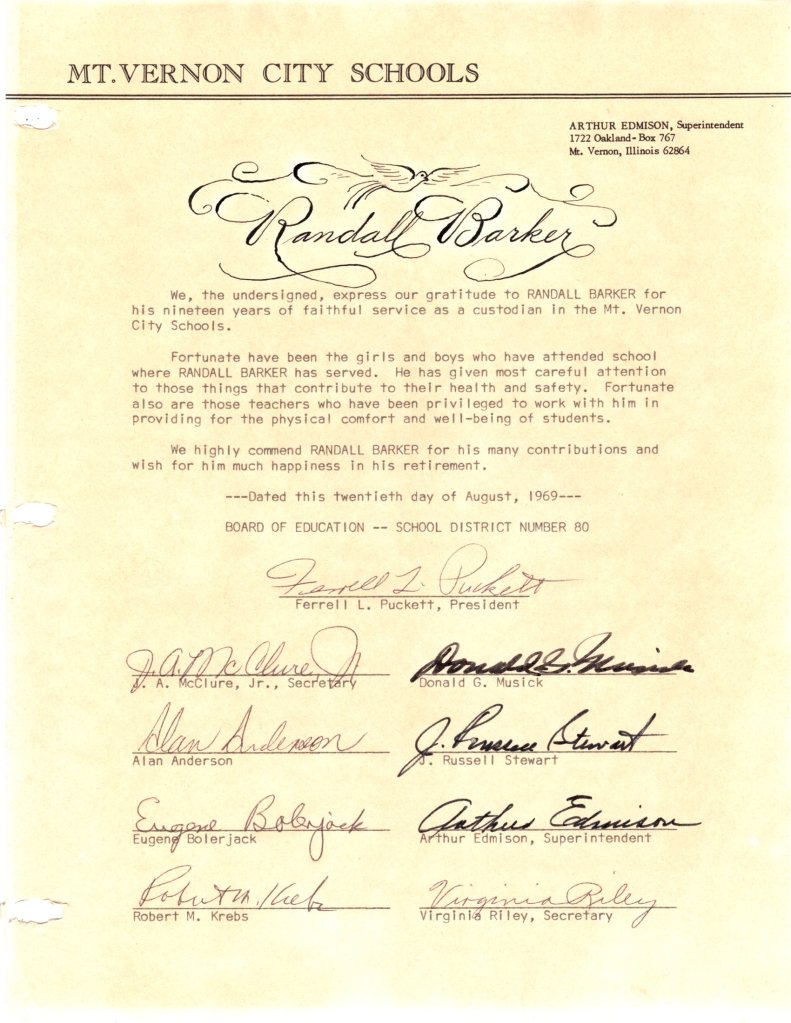
My grandfather, Randall Barker, with my mother. I don’t know the location…it looks like a country church. And below, my great-grandmother Barker, an Illinois teenager in the 1890s, wearing the true prairie dress.
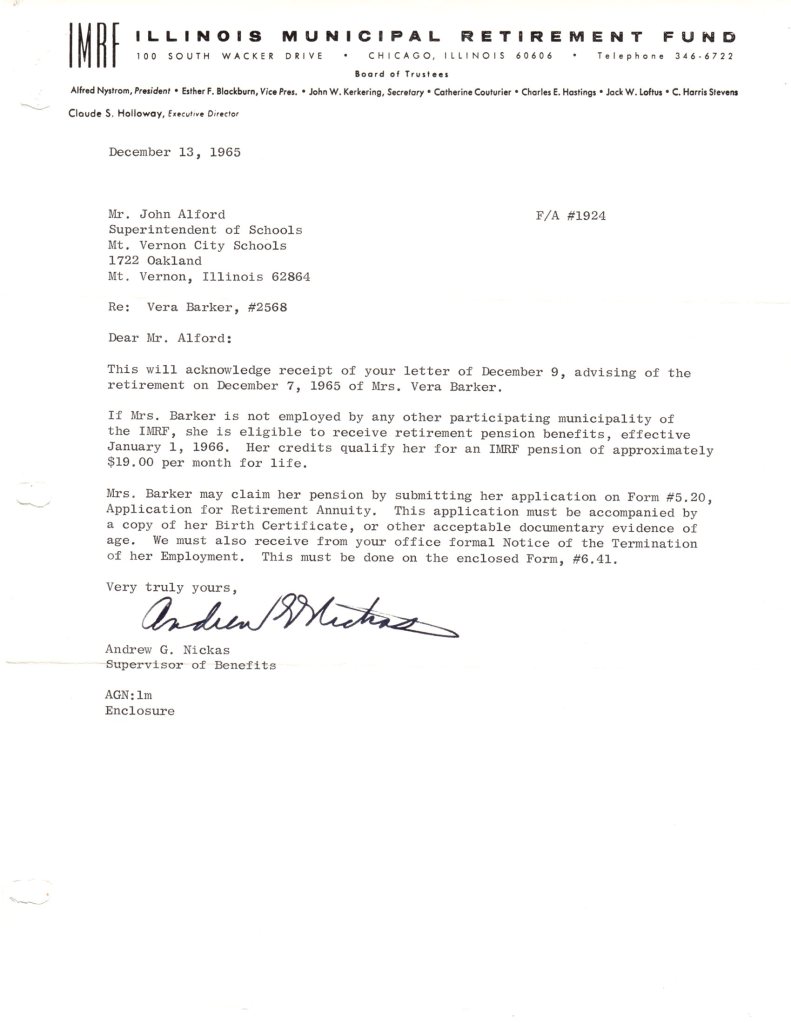
My grandmother had only an eighth-grade education, and grew up on a farm. She and my grandfather were able to work at a variety of jobs, at the Mount Vernon shoe factory (Brown Co., I believe), eventually in the school system. Just to editorialize, let me raise the question of whether the changes in the workplace reflect a difference in the work force itself? Do “unskilled” people today get pushed farther to the margin, although they, like the generations before them, will learn how to do their jobs, on the job? We have certifications and diplomas, the lack of which shut people out, while the people themselves must be as intelligent and capable as ever. My grandparents saved, bought and paid off a house, saved more, and left a legacy that helped me pay off my student loans. Are today’s unskilled workers not shut out of the housing market, for the disproportionate cost by percentage of income?
When I was growing up, we had a farm (a property with house and acreage, not a working farm) in Meigs County, Ohio. We went to play in the woods and fish, and be spooked by imaginary ghosts in the attic, on weekends. And whenever we came back on a Sunday evening, we’d have Canadian bacon sandwiches and watch these shows we loved. (Not so much, McCloud. But Columbo and McMillan and Wife.)






 Memories of a Midwestern Family