I’ve been reading archived newspapers from 1979, a time in my life when I didn’t pay too much attention to world events. Now that I’m doing my bit for recorded history, I enjoy reminding myself, or educating myself, on vaguely remembered moments from the years I actually lived through. I came across a piece in the New York Times, that had Senator John Glenn being shown the facade of a Washington building, and told by his guide that there was more radiation emanated by the granite than was detectable in the air around Three Mile Island (the accident occurred March 28, 1979).
That made me curious about my favorite garden rock, above. I learned, doing a little research, that pink and red granites give off more than greys and blacks—a combination of radon gas and gamma rays, chiefly. Unfortunately, a Geiger counter won’t detect levels in granite reliably, if at all, due to ordinary background radiation in the environment. And the other machines, for non-professionals, are too expensive to buy. So I guess I’ll never know how powerful my pink rock is.
(If you have granite countertops, don’t worry. Here is a PDF from the Health Physics Society explaining more.)
Hawk’s Print
Above, a thing you don’t see often, since birds of prey don’t walk on the ground. But they do rocket down from the treetops onto passing squirrels and rabbits. At night, I seem to have a lot of owl activity around my ground feeder as well, to judge by the number of pellets I find. I don’t know what comes out, whether it’s mice or flying squirrels…but whatever they are, they aren’t very wary. The owls seem to be picking them off constantly.
It is walled with the money we meant to have saved
And the pleasures for which we grieve.
The kind words unspoken, the promises broken,
And many a coveted boon,
Are stowed away there in that land somewhere—
The land of ‘Pretty Soon.’
There are uncut jewels of possible fame
Lying about in the dust,
And many a noble and lofty aim
Covered with mould and rust.
And oh this place, while it seems so near,
Is farther away than the moon;
Though our purpose is fair, yet we never get there—
To the ‘Land of ‘Pretty Soon.’
The road that leads to that mystic land
Is strewn with pitiful wrecks,
And the ships that have sailed for its shining strand
Bear skeletons on their decks.
It is farther at noon than it was at dawn,
And farther at night than at noon;
Oh let us beware of that land down there—
The land of ‘Pretty Soon.’
1899, ELLA WHEELER WILCOX
To ask why evil exists here below is to ask why a contingent being is not an absolute being, why man is not God.
Gottfried Liebniz
From History of Jefferson County
Perrin 1883
Brain Tanning
A great deal of clothing was made of deerskin before the raising of cotton and flax. The first efforts to tan the hides were almost a failure. A new effort, however, was introduced, which was much better. This was, after removing the hair, the skins were thoroughly rubbed and dressed with brains. They were then stretched on stakes driven into the ground around a large hole, and the hole was filled with light and rotten wood, which was set on fire. The warmth caused the brains and oil to permeate the skins and the smoke gave them a beautiful color. Tanned in this way, they were said to be very soft and pliant, and were handsome.
An anecdote of Judge G. W. Wall, born in Chillicothe, Ohio, April 22, 1839, moved in infancy to Perry County, Illinois.
He was attorney for the Illinois Central Railroad, and while thus acting, a good story is told of him. He was called upon to attend a case at Effingham for the railroad, which had been sued by a citizen for the value of stock killed by defendants’ train. The venerable and every-ready O. B. Ficklin was prosecuting the company, together with some other attorney whose name is not now remembered. The evidence was heard, and counsel went to the jury. The plaintiff’s case was opened by Ficklin’s associate, who indulged in considerable bunkum and bombast about giant corporations, etc. After he closed, Wall replied for the defense, and during the course of his remarks compared the gentleman who had preceded him to Dickens’s famous character of “Sergeant Buzfuz”, and, as he thought, completely annihilated the gentleman, and left nothing to be done but for the jury to return a verdict for the defendant, and thus closed his case.
It was now time for Ficklin to make the closing argument for the plaintiff, and after speaking to the testimony and the law, he concluded in the following vein of pathetic and injured innocence:
“And now, gentlemen of the jury, it becomes my painful duty to reply to the malignant and uncalled for attack upon one of the best men this country ever produced; a man who has long since slept with his fathers, and upon whose character no man, until today, has dared to cast the shadow of suspicion. I allude, gentlemen of the jury, to the attack of my young friend Wall, upon the memory of that good and kind man, Sergeant Buzfuz. Gentlemen, it was not, perhaps, your privilege, as it was mine, to have known him personally. I remember him well, in the early and trying times of this country. He first assisted to cut out the roads through this county. He was the early pioneer, who was ever ready and willing, with honest heart, and active hand, to aid a friend or brother in distress. In fact, gentlemen of the jury, there are few men, living or dead, that this country owes more to than it does to my old friend Sergeant Buzfuz. It is true, gentlemen, that he was somewhat uncouth and blunt in his way, but his every action, I assure you, was prompted by a noble and honest motive. He was not blessed with the brilliant and accomplished education of my young friend. He, gentlemen of the jury, wore no starched shirt or fine neckties; he was humble and retired. In his leather leggings and hunting shirt he went about the country, not as a rich representative of a railroad monopoly, but as an humble citizen doing good to his fellow-man. His bones have long since moldered into dust; the sod grows green over his grave; his work is done, and he is gone from among us to return no more forever; and I was surprised to hear his just and amiable character attacked in the manner it has been on this occasion; and it is impossible for me, his last remaining friend, to permit it to go by unnoticed. And to you, sir [turning to Wall, who was by this time completely dumbfounded], I say no better man ever lived than he whom you have so unjustly abused. Youth, sir, should have more respect for the men who have made life pleasant for those who come after them, than to assail their character in the manner you have done”; and thus he continued until his close, with great earnestness, and the utmost apparent sincerity. At its close, the jury could hardly wait until they could write their verdict for the full amount of damages claimed by the plaintiff, and, it is said, so worked up were they that Wall had difficulty in escaping personal violence.
In the early 1980s I was able to afford, on less than five dollars an hour, a two-bedroom townhouse apartment, off Route 161 in Columbus, Ohio. My weekly food budget was twenty dollars, and I had about fifty dollars a week for disposable income—which I spent on clothes, decorating, houseplants, fish tanks, LPs. I was a Pier One shopper, buying those peacock feathers 80s people displayed in floor baskets; giant floor pillows, too, with a folkish loose-woven fabric, and straw mats I used for wall hangings. One purchase I carried from house to house for several years before it fell apart was a twenty-five dollar rattan chair, bought with Christmas money from my grandparents (typically a check for twenty-five dollars).
I used to hurry home on my lunch break in those days to watch videos on MTV (and at Gold Circle we didn’t have to clock in and out, so I pushed the time). I was crushing on the band Split Enz, loved Elvis Costello, bought an album by Squeeze on the strength of a Rolling Stone review. (Agreed with…however, reviewers in those days had the power to snuff out a lot of good music. The internet’s democratic openness is an improvement.)
I had the Steve Miller Band for “Fly Like an Eagle”… I had a couple of Styx albums (when I was a teenager I thought “Come Sail Away” was the most beautiful song), but I started to go off them in the 80s. Of course, “Mr. Roboto” is immortal.
Check out this Tommy Shaw solo number from the 80s. A truly great song that wasn’t the hit it should have been.
The job I had was general clerking in what I think was called the Merchandise Information Office (I’m not sure about the “I”) at the chain’s central office in Worthington (next to the Jack Maxton car dealership). People from the region—but also from California, where a string of stores sat detached from the others—will recall GC as Kmart-like.
They had (the one on Morse Road, the one I shopped at) just before I quit my job started stocking a little section of higher-end brands, as a marketing experiment…
So, in that last month or two, with the employee discount, I drove off in my Chevy Chevette (I think it was a stick, light metallic blue, only AM radio) to shop for a brand I liked, Outlander. One purchase was a silk-angora blend collared sweater in off-white, that I paired with a turquoise pinwale circle skirt. The waist on this was too tight; I had to fix it with a safety pin…so not the most successful look. I liked the turquoise and white combo, though. One of my 80s outfits was a pair of huge parachute pants I wore with a white eyelet-collared blouse. I still have an Outlander red lambswool blend with three-quarter sleeves and v-neck, now somewhat moth-eaten, that I wore with a long midwale corduroy dirndl, dark brown (bought during a Myrtle Beach vacation), and some Nine West boots, dressy in cinnamon with a stacked heel.
Why so much detail? Just to paint the picture for you, if you remember those fashions. And because a lot of things in life are measured in clothes. (If you don’t remember, you’ll have to Google parachute pants to get the full sense of them.)
There was a sort of dynamic I didn’t understand, coming into the work world as a poorly socialized eighteen-year-old. Once, for example, some of the supervisors were throwing a party for the office staff at Chuck E. Cheese’s, and I didn’t want to go. It was an after work-hours affair, so I understood it to be voluntary. I got the impression my opting out was being held against me, in a background gossipy way.
There are voluntary things on the job that are not voluntary, such as overtime. (But I’ve steadfastly refused overtime whenever I could.)
And I still think a lifetime of never setting foot in a Chuck E. Cheese has done me only good.
Favorite Foods of the Day
Lender’s Garlic bagels, that they stopped making. Toasted, with peanut butter.
Granny Smith Apples. (There are lots of great, crispy apples these days, but back then, you could have Granny Smiths or mushy, bland golden and red delicious.)
Honey Nut Cheerios
Stouffer’s Mac and Cheese (This always had to be made in the oven to brown the cheese topping and bake the filling to a custardy quality. Microwaving wouldn’t do. But, last time I bought any, they’d changed it weirdly and it tasted like it sat open in the refrigerator for a week.)
There was a candy, a type of M & Ms called Mint Royales, that I loved.
And once, you could get really good Dolly Madison Danish. I think they’ve gone by the wayside.
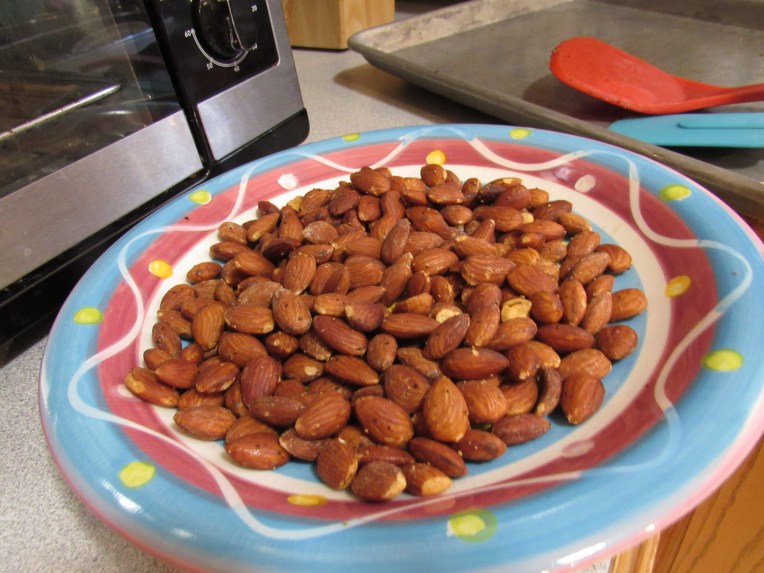
This is an easy snack, just two cups of raw almonds, one tablespoon of mayonnaise, and 1/4 teaspoon of black pepper. Put the nuts in a bowl, stir in the mayonnaise and pepper until they’re all well-coated, then spread them on a baking sheet, and bake at 350 degrees. When they begin to brown, and smell a little like french fries, they’re done.
Today’s story is about TV movies, back when the movie-of-the-week was a big deal.
My sister Tracy and her friends were older, so they always had something they were into that came to me, the little sister trailing along, as sort of mysterious, since I was never there at the first discovery of it. Tracy was in middle school two years before I was, and in high school two years before I was.
So her gang knew this movie was going to be on TV, or they had all read that particular book. They were involved in Ohio University theater for a few years, as something like junior groupies. I don’t know who it was that opened the door for them; probably one of the sisters of her best friend from those days. One year the musical Carousel was a fascination, and the “older” man playing Billy Bigelow (a college student in his twenties) was a big crush. I think I saw him once (I picture him looking like Hugh Laurie with the hair of Art Garfunkel), but I don’t remember if I saw the show.
We were all singing “If I Loved You” and “What’s the Use of Wondering”, around the house.
A TV movie we were excited about seeing was called “A Howling in the Woods”. It aired in 1971, and starred Barbara Eden and Larry Hagman, also John Rubenstein, who I thought was very cute (look up his youthful pictures and you’ll agree), when he was in the TV show “Family”. I think, as to “Howling”, I never saw the whole thing, probably due to bedtime, but I remember the ads for this one, with Barbara Eden getting out of a car wearing a red hat, very glamorous.
“Brian’s Song”, also 1971, the football/cancer story starring Billy Dee Williams and James Caan. Truly a weeper, and we girls loved all the poignant things of the era, like the song “Honey” by Bobby Goldsboro, (1968), or “Seasons in the Sun”, Terry Jacks (1974).
Powell Kenzie has wandered, living the life of a vagabond, since his discharge from the army. The year is 1948. He finds himself in a small New England town, by watchman Lloyd Guy given temporary shelter in the remains of the Drybrook works. On the hill opposite sits the family’s empty house. Taken with an urge to settle, Powell conceives a plan to prove his usefulness. He meets Heinz Rohdl, a man seemingly insane. Then a visitor named Summers arrives to tell a ghost story.
Stories are from the American Watchman and Delaware Advertiser, October 15, 1824
Prince Saunders, a New England free black, through his public speeches and writings, led a movement under the protection of the Haitian king, Henry Cristophe (who had assumed the role, there being no hereditary royal line in Haiti, which rebelled from the control of France in 1791, and became independent in 1804). This movement attracted thousands of emigrants, but the dream of creating an economic base for free blacks with full equality of citizenship, was quashed by a fresh rebellion on the island.
The Time of a Black Boy
For Sale. He has been brought up in the country, on a farm, has six years to serve, and is stout and healthy. Inquire at the office of the Watchman.
[Contracts of apprenticeship could be bought and sold.]
What Next?
A short time since, an extraordinary operation was performed at the Kent and Canterbury hospital, upon a man whose sound thighbone was cut open, and an old decayed bone extracted. The man is now so much recovered as to be walking about the streets of Canterbury. We have now to record one almost as extraordinary, and which has been attended with the happiest results. A patient was received at the hospital some time since, with a very diseased liver. After some time, the case assumed the worst possible appearance, and it was resolved as the only chance of preserving life, to tap the liver. The operation was performed by Dr. Fitch, senior surgeon, in presence of other gentlemen of the faculty connected with the establishment. Upon the liver being touched, upwards of five pints of diseased matter immediately flowed from the wound. A tube, nine inches in length, was then introduced and retained in the wound, through which a pint of the same fluid was daily evacuated for a week! The poor man is getting quite well. Kent (Eng.) Herald
Emigration to Hayti
Emigration to Hayti is progressing with unexampled rapidity; it is not a mere experiment, but vessel after vessel is despatched.
The New York Evening Post of Tuesday says:
The ship Concordia is expected to sail this afternoon, or tomorrow morning, from this port for Hayti, with about 160 colored persons of both sexes. Six vessels at Philadelphia, one at Port Elizabeth, one at Alexandria, and several others at Baltimore, are on the eve of sailing for the same destination. It is calculated that between three and four thousand of these persons will leave the United States within a few days, and that every fortnight additional numbers will be shipped off under the direction of President Boyer’s agent, who pays the expense of their transmission by authority of the Haytian government. One hundred of those about to sail from this port, are from the state of New Jersey, and there can be no doubt that the great advantages held out will induce the mass of this part of our population to withdraw from the country.
Dept. of State
Washington 15 Sept. 1824
NOTICE
Citizens of the United States having Claims, under the Treaty of Ghent, for slaves and other private property, taken from them during the late war between the United States and Great Britain, are hereby notified, That the Definitive list, required by the subjoined article of the Convention of St. Petersburg, will be laid before the Joint Commission for ascertaining and determining the amount of such Claims, at its next meeting, in this City, on the 8th of December, in the present year; that such as have not already exhibited their Claims, and the evidences of them, to this Department, may do so before that time.
Article III
When the average value of slaves shall have been ascertained and fixed, the two commissioners shall constitute a board for the examination of the claims which are to be submitted to them, and they shall notify the Secretary of State for the United States, that they are ready to receive a definitive list of the slaves and other private property, for which the citizens of the United States claim indemnification: it being understood and hereby agreed that the commission shall not take cognizance of, nor receive, and that his Britannic Majesty shall not be required to make compensation for any claims for private property under the first article of the Treaty of Ghent, not contained in the said list. And his Britannic Majesty hereby engages to cause to be produced before the commission, as material towards ascertaining facts, all the evidence of which his Majesty’s government may be in possession, by returns from his Majesty’s officers, or otherwise, of the number of slaves carried away. But the evidence so produced, for its defectiveness, shall not go in bar of any claim or claims which shall be otherwise satisfactorily authenticated.
Me (Stephanie), on the left, my sister Tracy on the right. I don’t know how old I am in this picture…one or two years.
And, a few announcements from the year 1820, transcriptions I make to give family tree aficionados a taste of what their ancestors might have been influenced by, or talking about.
The Hillsborough Recorder (NC) August 16, 1820
The governor of Virginia offers a reward of $500.00 for George Hamblet, who committed a deliberate murder on a negro man, his slave, accompanied by circumstances of the most savage cruelty.
It is said, that the following gives the respective ages of the surviving political patriarchs who signed the Declaration of Independence:
William Floyd, of New York….87
John Adams, of Massachusetts….85
Thomas Jefferson, of Virginia….83
Charles Carroll, of Maryland….82
Gentlemen are requested not to kill a belled buzzard, which is ranging about this neighbourhood. It was belled at Yankee Hall in May last.
William W. Hall
Alexandria Gazette and Daily Advertiser, July 22, 1820
Liver Stable
Elizabeth Towers
RETURNS her sincerest thanks to the public for the liberal encouragement her late deceased husband received in the above business for this twenty years, and informs his friends and the public in general, that she still continues the above business at the former stand, where every attention will be paid that formerly was, to render ample satisfaction to those Ladies and Gentlemen that will honor me with their custom, as she has a large family to support, and through no other means.
Notice
PROPOSALS will be received at Fort Washington until June 20th for supplying the troops and laborers with FRESH BEEF twice a week for one year.
R. B. Lee, Lt. U.S.A.
A Card
Those ladies and gentlemen who witnessed the great exertions of Mr. and Master Napey to entertain them by the ascension of their balloon, and who were prevented by the crowd from approaching the old gentleman to contribute their mite to remunerate him, are respectfully invited to call at his place of abode, at the corner of Prince and Fairfax, to enable him to proceed to his friends at New York.
Mr. Napey takes this occasion to return his thanks to the citizens of Alexandria for their great kindness and liberality to him during his stay in town, and regrets that some untoward circumstances prevented him from fully executing his plan as it regarded his balloons yesterday.
(A novella; this volume also contains the short story “Are You Jealous”)
A sojourn in St. Petersburg creates an odd resonance for Minta Castelberry, touring this most European of Russian cities, with her mother-in-law. The women are accosted by an insinuating stranger. John Emmett insists on telling his story, and Minta soon finds that his arrogance hides a melancholy soul…and finds herself invested in his quest. Then she finds this crossing of paths is no coincidence.
Most of my growing-up years, my family lived on Shannon Avenue in Athens, Ohio. Early on, when my parents first bought the house, a little cache of some former owner’s WWII souvenirs was found in the attic. My sister got to add to her things an “Aussie” hat, a cool article to play dress-up with. I got to keep these two items, the soldier’s campaign medal and a 1945 franc—a significant issue, after the country got its own government back. I would agree with anyone who feels we should not have had these things to play with, but seventy-four years on, I don’t know if the rightful descendants can ever be located.
Above, my cats at play, and a little accompanying music.
This is my latest book of poetry, which you can get on Kindle or as a paperback.











 Memories of a Midwestern Family